
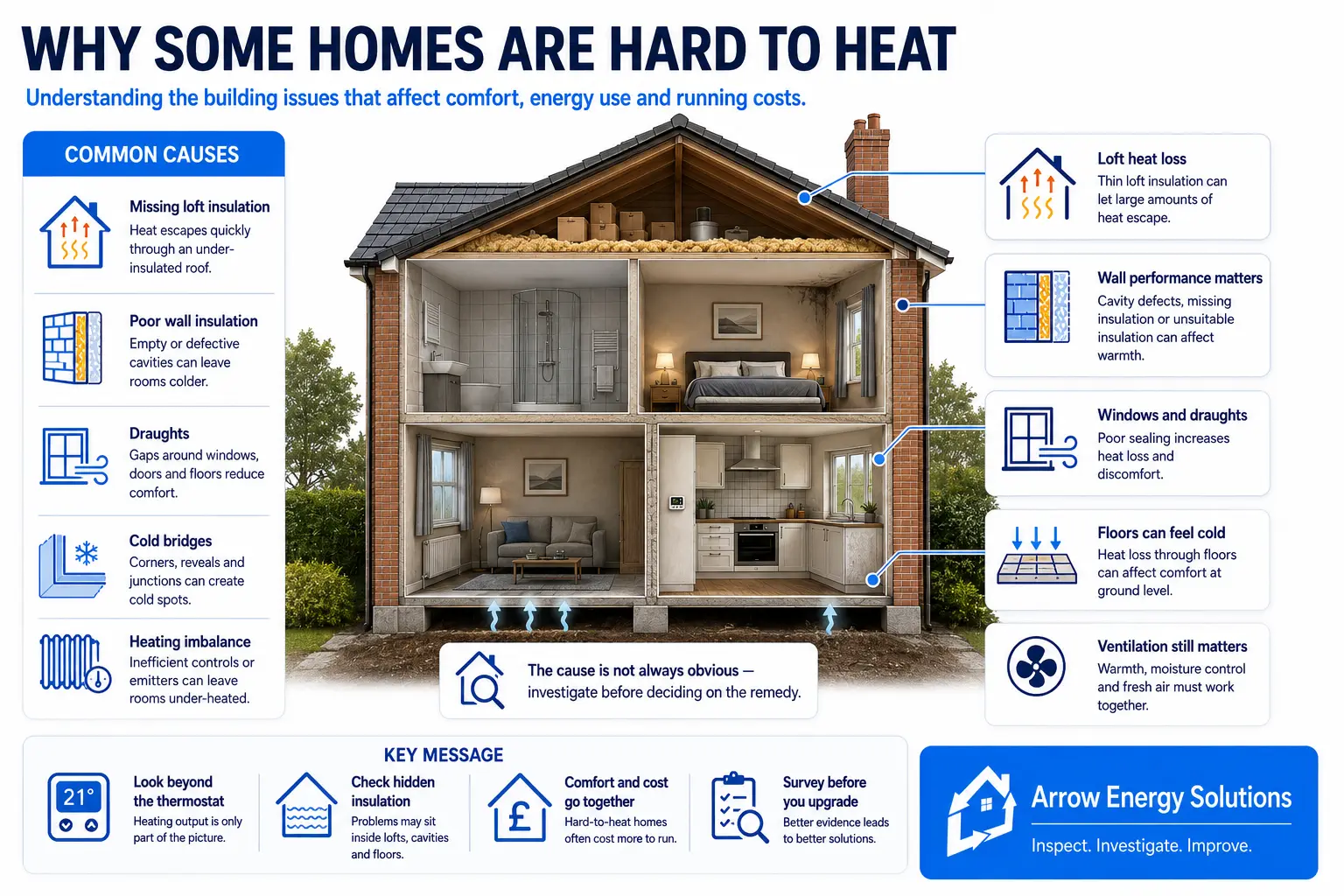
Some homes seem difficult to keep warm no matter how long the heating is left on.
One room may always feel colder than the others, the heating may appear to run constantly, or the house may cool down very quickly once the heating switches off.
The obvious reaction is often to blame the heating system.
But in many cases, the real issue is the building itself.
A boiler, heat pump or other heating system puts heat into the property.
The building fabric determines how quickly that heat escapes.
If the walls, roof, floors, windows or other parts of the property are losing heat rapidly, even a powerful heating system may struggle to maintain a comfortable temperature.
This is why improving the thermal performance of the building can sometimes make more difference than simply installing a larger heating system.
Heat rises, so insufficient loft insulation can allow a substantial amount of warmth to escape through the roof.
Older properties may have very little loft insulation, while others may have insulation that has been disturbed, compressed or poorly installed.
Increasing loft insulation can often provide a noticeable improvement in comfort.
External walls can also be responsible for significant heat loss.
A cavity wall may be completely empty, partially insulated or contain older insulation that is no longer performing as expected.
Poorly distributed insulation can leave sections of wall significantly colder than others.
This may contribute to cold rooms, cold internal surfaces and condensation.
Cold air entering around windows, doors, floors and other openings can make a home feel uncomfortable even when the measured room temperature appears reasonable.
Small gaps across a property can collectively create a significant amount of uncontrolled air movement.
Reducing unnecessary draughts can improve comfort and reduce the amount of heat required to maintain the desired temperature.
Certain areas of a building can conduct heat more readily than surrounding materials.
These areas are known as thermal bridges.
They often occur around:
Window and door openings
Corners
Structural elements
Floor and wall junctions
Roof junctions
These areas can feel noticeably colder and may also become locations where condensation and mould develop.
Ground floors can sometimes make an entire room feel uncomfortable.
This is particularly noticeable in older properties, suspended timber floors and rooms over unheated spaces.
Even when the air temperature is reasonable, cold floors and other cold surfaces can make occupants feel considerably colder.
Sometimes the problem really is the heating system.
Radiators may be undersized, poorly balanced or positioned incorrectly.
Controls may also be unsuitable for the way the property is used.
However, replacing or upgrading heating without understanding the building fabric can result in a larger system simply compensating for unnecessary heat loss.
A well-insulated home still needs appropriate ventilation.
The objective is to control unnecessary heat loss while allowing enough fresh air to manage moisture and maintain healthy indoor conditions.
Insulation, heating and ventilation should therefore be considered together.
A single cold room may indicate a localised problem.
Possible causes include:
Missing cavity wall insulation
Poorly distributed insulation
Greater external wall exposure
Roof or loft insulation defects
Draughts
North-facing walls
Thermal bridging
Heating imbalance
Damp building materials
A targeted investigation can help establish why that room behaves differently from the rest of the property.
If a home is consistently difficult to heat, it is worth understanding where the heat is going before spending money on larger boilers, heat pumps or additional radiators.
A building-fabric investigation may identify relatively simple improvements that substantially reduce heat loss.
Arrow Energy Solutions provides specialist insulation surveys and investigations for homes that are cold, uncomfortable or expensive to heat.
Our services include:
Cavity wall investigations
Borescope inspections
Existing insulation assessments
Cavity wall insulation
Cavity wall insulation extraction
Loft insulation
Investigation of cold rooms and cold walls
The cause of a cold home is not always obvious.
Our objective is to understand what is happening within the building before recommending the appropriate solution.