
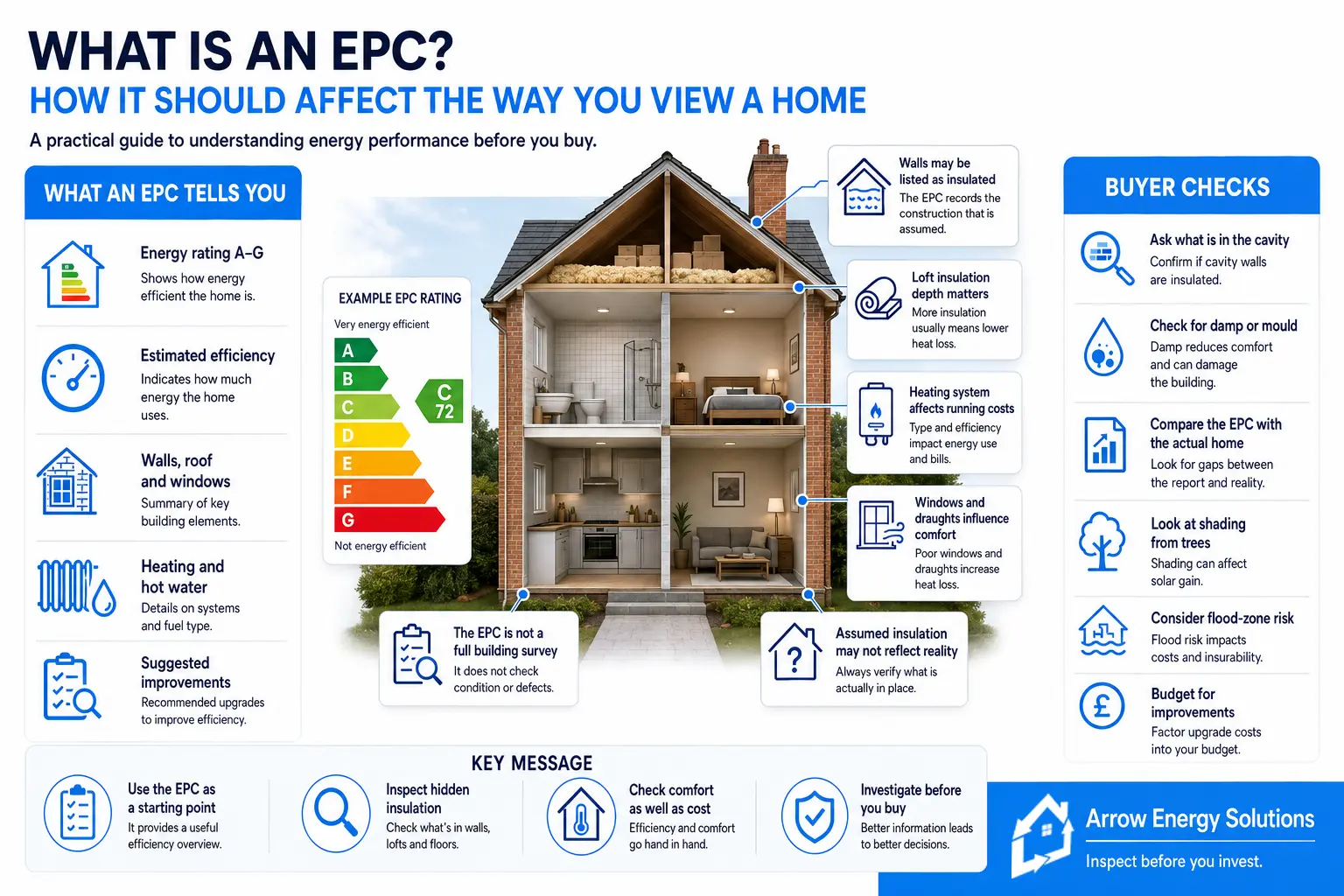
An Energy Performance Certificate, usually known as an EPC, provides a standardised assessment of a property’s energy efficiency.
It is an important document when buying or renting a home, but it should not be treated as a complete building survey or a guarantee that every insulation measure is present, effective or free from defects.
Understanding what an EPC tells you—and what it does not—can help you ask better questions when viewing a property.
EPC stands for Energy Performance Certificate.
The certificate gives a property an energy-efficiency rating from:
A – most energy efficient
B
C
D
E
F
G – least energy efficient
The rating is based on an assessment of the property’s construction, heating, hot-water system, lighting and known or assumed insulation.
The report also provides recommendations that may improve the rating and reduce the property’s modelled energy use.
In England and Wales, an EPC is generally required when a home is built, sold or rented.
The seller, landlord or letting agent must make the EPC available to prospective buyers or tenants when required. An existing certificate can be viewed through the government’s online EPC register.
An EPC normally remains valid for up to ten years, although the certificate may no longer reflect the current property if improvements or alterations have been completed since the assessment.
A domestic EPC normally includes:
The current energy-efficiency rating
The property’s potential rating
Estimated energy consumption
Modelled energy costs
Details of the walls, roof, floor and windows
Information about heating and hot water
Lighting information
Recommended energy improvements
Indicative installation costs
Potential savings
The environmental impact of the property
The recommendations may include measures such as:
Loft insulation
Cavity wall insulation
Solid-wall insulation
Floor insulation
Improved heating controls
A more efficient heating system
Solar panels
Low-energy lighting
Improved glazing
Renewable heating technology
The assessor records information about the size, age, construction and services within the home.
The rating is then calculated using the government-approved methodology rather than the household’s actual energy bills.
This is important because two households living in identical properties may use very different amounts of energy.
Actual bills are affected by:
The number of occupants
Working patterns
Thermostat settings
Hot-water use
Appliance use
Personal comfort preferences
Energy tariffs
How much of the property is heated
The EPC is therefore a standardised comparison tool rather than a prediction of exactly what your own bills will be.
The headline EPC rating is useful, but buyers should read the full certificate.
Pay particular attention to the individual descriptions of the walls, roof, floor, heating and glazing.
The EPC may state that the property has:
Cavity walls with insulation
Cavity walls without insulation
Solid brick walls
Solid walls with internal or external insulation
Timber-framed walls
System-built or non-traditional construction
The wall type is important because external walls are a major area of heat loss and some constructions are more complicated or expensive to improve than others.
However, an EPC entry stating that cavity insulation is present does not confirm that the material is still in good condition.
Older insulation may have:
Slumped
Shrunk
Deteriorated
Become wet
Been installed unevenly
Left substantial unfilled areas
A cavity inspection may therefore be worthwhile, particularly in an older property or where internal walls feel unusually cold.
Check whether the EPC records loft insulation and what depth has been assumed or observed.
During the viewing, consider:
Is the loft accessible?
Is the insulation evenly installed?
Has it been compressed by storage?
Are there large gaps?
Are pipes and tanks suitably protected?
Is ventilation at the eaves maintained?
Is boarding preventing an adequate insulation depth?
Are there signs of roof leaks or condensation?
An EPC may identify that insulation exists without providing a detailed assessment of workmanship or condition.
Look at the type and age of the heating system.
Consider:
Is it gas, oil, electric or heat-pump based?
How old is the boiler or heat pump?
Are there modern heating controls?
Are radiators appropriately sized?
Is the hot-water cylinder insulated?
Are pipes insulated?
Are there service records?
Does the whole home appear to be heated effectively?
A reasonable EPC rating does not guarantee that the heating system has been well maintained.
The EPC may record whether the property has single, double or triple glazing.
When viewing, also check for:
Failed sealed units
Condensation between panes
Draughts
Damaged seals
Poorly fitted doors
Rotting frames
Missing trickle vents
Mould around reveals
The quality and condition of the installation can matter as much as the glazing description.
An EPC is not a structural survey, damp survey or cavity wall inspection.
It does not normally provide a detailed assessment of:
Roof condition
Structural movement
Water penetration
Failed damp-proofing
Plumbing leaks
Cavity debris
Corroded wall ties
The condition of hidden insulation
Mould behind furniture
Defective drainage
Electrical safety
Boiler condition
Ventilation performance
Installation workmanship
A property may have a relatively good EPC rating and still contain costly defects.
Similarly, a home with a poor EPC rating may be structurally sound and offer an opportunity for carefully planned improvement.
EPC assessments cannot always confirm every hidden construction detail.
Where documentary or visual evidence is unavailable, the certificate may use assumptions based on the property’s age and construction type.
Phrases such as the following should prompt further questions:
“Insulation assumed”
“As built”
“No insulation assumed”
“Limited access”
“Unknown”
“From inspection”
An assumption is not the same as physical confirmation.
For example, the age of a property might suggest that cavity wall insulation was installed, but only a cavity inspection can establish what material is present and its current condition.
An EPC should form part of your overall assessment of the property.
A lower rating may indicate that the home could:
Be more expensive to heat
Feel colder in winter
Require insulation upgrades
Need a replacement heating system
Require improved glazing
Be less suited to a heat pump without further work
Before making an offer, consider obtaining realistic costs for the recommended improvements.
The figures shown on the EPC are indicative. Actual costs can vary considerably depending on access, property size, construction, location, defects and the standard of finish required.
The EPC normally shows both the current rating and a potential rating.
The potential rating assumes that the listed recommendations are completed.
This does not necessarily mean every recommendation will be:
Technically suitable
Affordable
Permitted
Practical
Appropriate for the construction
Guaranteed to produce the modelled saving
Listed measures should be investigated individually.
For example, cavity wall insulation should only be installed after the cavity and external walls have been assessed for suitability.
A home does not need to achieve a particular EPC rating simply to operate a heat pump successfully.
However, the condition of the building fabric has a major influence on the property’s heat loss and the design of the heating system.
Before installing a heat pump, the property should have a proper room-by-room heat-loss calculation. Practical insulation improvements should also be considered so that the system can operate efficiently at lower temperatures.
The EPC can help identify possible improvement areas, but it is not a substitute for a detailed heat-pump design or insulation survey.
Energy efficiency is becoming increasingly important to many buyers and tenants because it can affect:
Expected energy use
Comfort
Heating-system choices
Environmental impact
Future improvement costs
Suitability for renewable technology
A property with a stronger EPC may be more attractive, but the quality of the actual improvements remains important.
Good insulation that has been professionally surveyed and correctly installed is more valuable than a rating based on assumptions or defective historic work.
When viewing a home, ask:
When was the EPC completed?
Have improvements been made since then?
Are certificates or guarantees available?
What type of wall insulation is installed?
Has the cavity ever been inspected?
Has any insulation been removed or replaced?
How old is the loft insulation?
Are there records for the heating system?
What are the seller’s actual annual energy costs?
Are there any known damp or condensation issues?
Are there cold rooms or areas that are difficult to heat?
Have solar panels or batteries been installed?
Are they owned outright or subject to an agreement?
The answers can help you decide whether further surveys are necessary.
The EPC is a useful starting point, but hidden insulation should not be accepted on the certificate alone where its condition could materially affect the property.
Arrow Energy Solutions provides pre-purchase cavity wall and insulation surveys throughout the South of England.
Our surveys can help establish:
Whether cavity insulation is present
What type of material has been installed
Whether the insulation has deteriorated
Whether significant voids are present
Whether the cavity contains debris
Whether extraction may be required
Whether the walls may be suitable for a replacement system