
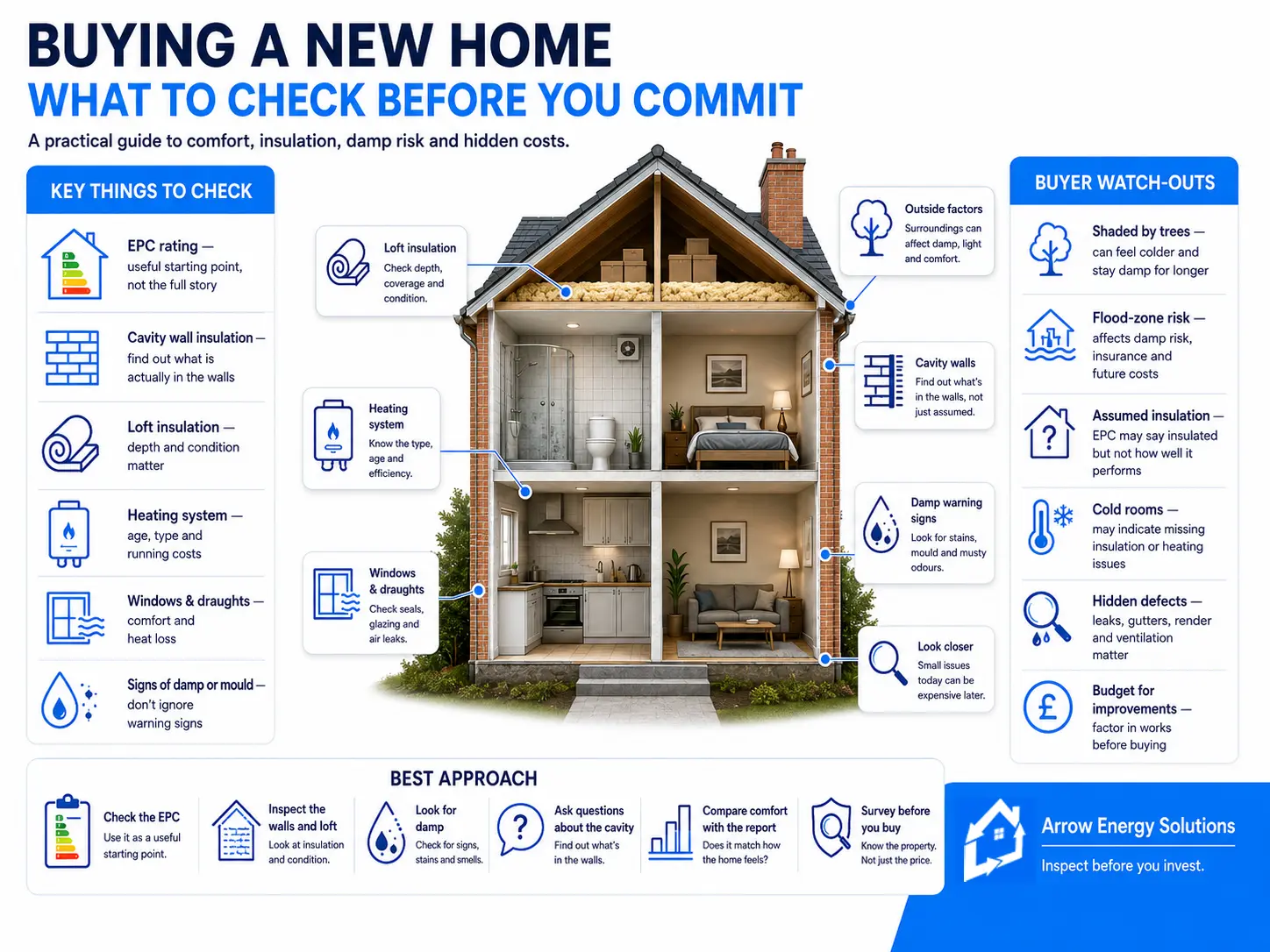
Buying a home is one of the largest financial commitments most people will ever make.
Location, room sizes, appearance and asking price are usually at the front of a buyer’s mind. However, the energy performance of the property can have a significant effect on comfort, heating costs and the amount of improvement work required after completion.
A home may look attractive during a viewing but still be difficult to heat, poorly insulated or vulnerable to damp and condensation.
Before committing to a purchase, it is important to understand how the building performs—not simply what its Energy Performance Certificate says.
Two homes of a similar size can have very different heating costs.
The difference may be caused by:
The construction of the walls
The amount and condition of the insulation
Loft-insulation depth
Window and door performance
Air leakage and draughts
The age of the heating system
Moisture within the building
The orientation of the property
Shade from nearby trees or buildings
Exposure to wind and rain
The temperature preferences of the occupants
A poorly performing property may feel cold even when the heating is running.
Cold walls and uneven temperatures can also increase the risk of condensation, mould and discomfort.
Understanding these issues before purchase helps buyers budget properly and avoid discovering expensive problems after moving in.
An Energy Performance Certificate provides a useful overview of the property’s modelled energy efficiency.
It normally includes information about:
Wall construction
Roof and loft insulation
Windows
Heating
Hot water
Lighting
Recommended improvements
Current and potential EPC ratings
However, an EPC is not a detailed building survey.
It cannot normally confirm the full condition of hidden insulation, and it may rely on assumptions based on the age or construction of the property.
For example, the EPC may say:
“Cavity wall, insulated”
“Cavity wall, insulation assumed”
“Roof insulated”
“Loft insulation, limited”
“Walls insulated as built”
These descriptions are useful, but they do not necessarily tell you:
What insulation product is present
How old it is
Whether it fills the cavity evenly
Whether it has slumped or deteriorated
Whether it has become damp
Whether large uninsulated areas remain
Whether the cavity contains rubble or debris
Whether the insulation is suitable for the building
Whether the original installation was completed correctly
A property can therefore be recorded as insulated while still performing poorly.
Cavity wall insulation is hidden inside the external walls.
Homebuyers cannot normally see it during a standard viewing, and even a general building survey may not establish its type or condition unless a specific cavity inspection is requested.
Older homes may contain:
Urea formaldehyde foam
Blown mineral fibre
White wool insulation
Polystyrene beads
Bonded EPS bead
Partial insulation from previous building work
A mixture of materials installed at different times
Some older materials can deteriorate over time.
Possible problems include:
Foam shrinking or breaking apart
Fibre settling toward the bottom of the cavity
Insulation becoming uneven
Material becoming contaminated by water ingress
Unfilled areas around windows and doors
Debris preventing the cavity from being filled properly
Insulation bridging moisture between the external and internal wall
If the insulation has failed, the home may still have an EPC entry showing that insulation is present.
The EPC records the known or assumed construction. It does not guarantee the current performance of the material.
A professional cavity wall survey may use a small borescope camera inserted through carefully positioned inspection holes.
This can help identify:
The type of insulation
Its distribution within the wall
Areas where the material has slumped
Large voids or missing sections
Damp or contaminated insulation
Rubble and mortar droppings
Wall-tie condition
Cavity width
Signs of water penetration
Whether extraction may be required
Several inspection points may be necessary because one part of the wall may differ significantly from another.
A single hole cannot always represent the whole property.
The energy performance of a home depends on more than cavity insulation.
Buyers should also consider the loft.
Questions to ask include:
How much insulation is present?
Is it installed evenly?
Has it been compressed by loft boarding?
Are there uninsulated areas?
Is ventilation at the eaves blocked?
Are water tanks and pipework protected?
Are there signs of roof leakage?
Is there condensation on roof timbers or felt?
Does a bathroom extractor discharge into the loft?
Loft insulation may appear on the EPC but still be inadequate, uneven or poorly installed.
The position and surroundings of a property can affect how quickly it warms and dries.
A home surrounded or heavily shaded by mature trees may receive less direct sunlight.
This can mean:
External walls remain wet for longer after rain
Roofs, gutters and render dry more slowly
Internal rooms receive less solar warmth
Ground and air around the home remain cooler
Moss and organic growth develop more readily
Condensation risk increases on colder surfaces
Leaves repeatedly block gutters and drainage
Trees do not automatically make a property damp, but dense shade can contribute to slower drying and colder building surfaces.
During a viewing, look for:
Moss-covered roofs
Algae staining
Green growth on walls
Blocked gutters
Damp ground around the property
Overhanging branches
Limited sunlight reaching principal rooms
Musty smells
Mould behind furniture
Dark staining on external walls
The orientation of the house also matters.
North-facing walls and rooms normally receive less direct sunlight and may feel colder, particularly during winter.
Large trees close to a building may also create additional maintenance concerns.
These can include:
Roots affecting drains
Branches damaging roof coverings
Leaves blocking gutters
Increased shade
Restricted air movement
Damage to render or masonry
Greater moss growth
Insurance or subsidence concerns in certain ground conditions
A specialist building or tree assessment may be appropriate where mature trees stand very close to the home.
A flood-zone designation should always be investigated before purchasing a home.
Flood risk does not necessarily mean the property has previously flooded, but it may affect:
Insurance availability
Insurance premiums
Mortgage lending
Future resale
Property maintenance
Damp risk
Drainage requirements
The cost of protective measures
Buyers should establish whether the potential source is:
River flooding
Coastal flooding
Surface-water flooding
Groundwater
Sewer flooding
Overflow from nearby drainage systems
Each type of flooding presents different risks.
If floodwater enters a property, moisture may remain trapped within walls, floors and insulation long after the visible water has gone.
Cavity insulation may become:
Saturated
Contaminated
Compressed
Displaced
Unable to dry properly
A source of persistent damp
Floodwater can also leave salts and contamination within plaster and masonry.
Even where a home has been redecorated, hidden damage may remain.
Ask the seller:
Has the property ever flooded?
When did it occur?
How high did the water reach?
What remedial work was completed?
Was cavity insulation removed?
Were walls professionally dried?
Were floors or plaster replaced?
Are reports or invoices available?
Has insurance ever been refused or restricted?
Visible fresh paint at low level should not automatically be treated as evidence of a problem, but it is reasonable to ask why redecoration was carried out.
A home in a flood-risk area can also suffer from unrelated moisture problems.
These may include:
High external ground levels
Defective drainage
Blocked air bricks
Leaking gutters
Damaged render
Bridged cavities
Plumbing leaks
Condensation
Poor ventilation
Failed insulation
The cause should be established before any remedial work is recommended.
Pay attention to more than visible decoration.
Look for:
Cold external walls
Mould in corners
Peeling wallpaper
Bubbling paint
Salt deposits
Musty smells
Condensation on windows
Staining below gutters
Cracked render
Damaged pointing
High external ground levels
Air bricks below the ground
Recently replaced skirting boards
Different paint finishes at low level
Dehumidifiers in use
Furniture positioned away from damp walls
Rooms that feel significantly colder than others
Open cupboards and, with permission, look behind large furniture where possible.
Damp and mould often develop in areas with limited air movement.
Sellers may genuinely believe that a home is well insulated because work was completed previously.
Ask for:
Installation certificates
Guarantees
Installer details
Building Regulations documentation
Invoices
Product information
Previous survey reports
Damp reports
Flood-repair records
Heating-service documents
Energy bills
Paperwork does not prove that insulation remains effective, but it can help establish what was installed and when.
The EPC should be used as a starting point.
Compare its descriptions with what you see during the viewing.
For example:
If the EPC says the loft is well insulated, inspect the loft
If the EPC says the cavity is insulated, ask what product is present
If the home feels cold despite a reasonable EPC, investigate why
If there is mould, do not assume it is only a ventilation issue
If the property is heavily shaded, consider drying and condensation risks
If the home is in a flood zone, investigate its history and insurance position
Any inconsistency deserves further investigation.
Before making an offer, consider the possible cost of:
Removing failed cavity wall insulation
Installing modern bonded bead
Upgrading loft insulation
Repairing gutters and downpipes
Replacing defective render
Improving ventilation
Addressing mould
Replacing the heating system
Upgrading radiators
Improving glazing
Installing flood-resilience measures
A lower purchase price may still represent good value, but only if the likely improvement costs are understood.
A general building survey is important, but it may not provide a detailed view inside the cavity walls.
A specialist pre-purchase cavity and insulation survey can help identify hidden problems before contracts are exchanged.
Arrow Energy Solutions can assess:
The type and condition of cavity insulation
Unfilled areas and voids
Failed foam or slumped fibre
Moisture and contamination
Cavity debris
Potential water penetration
Loft-insulation condition
Likely extraction requirements
Suitability for replacement insulation
Buying a home without understanding its insulation can lead to unexpected heating costs and remedial work.