
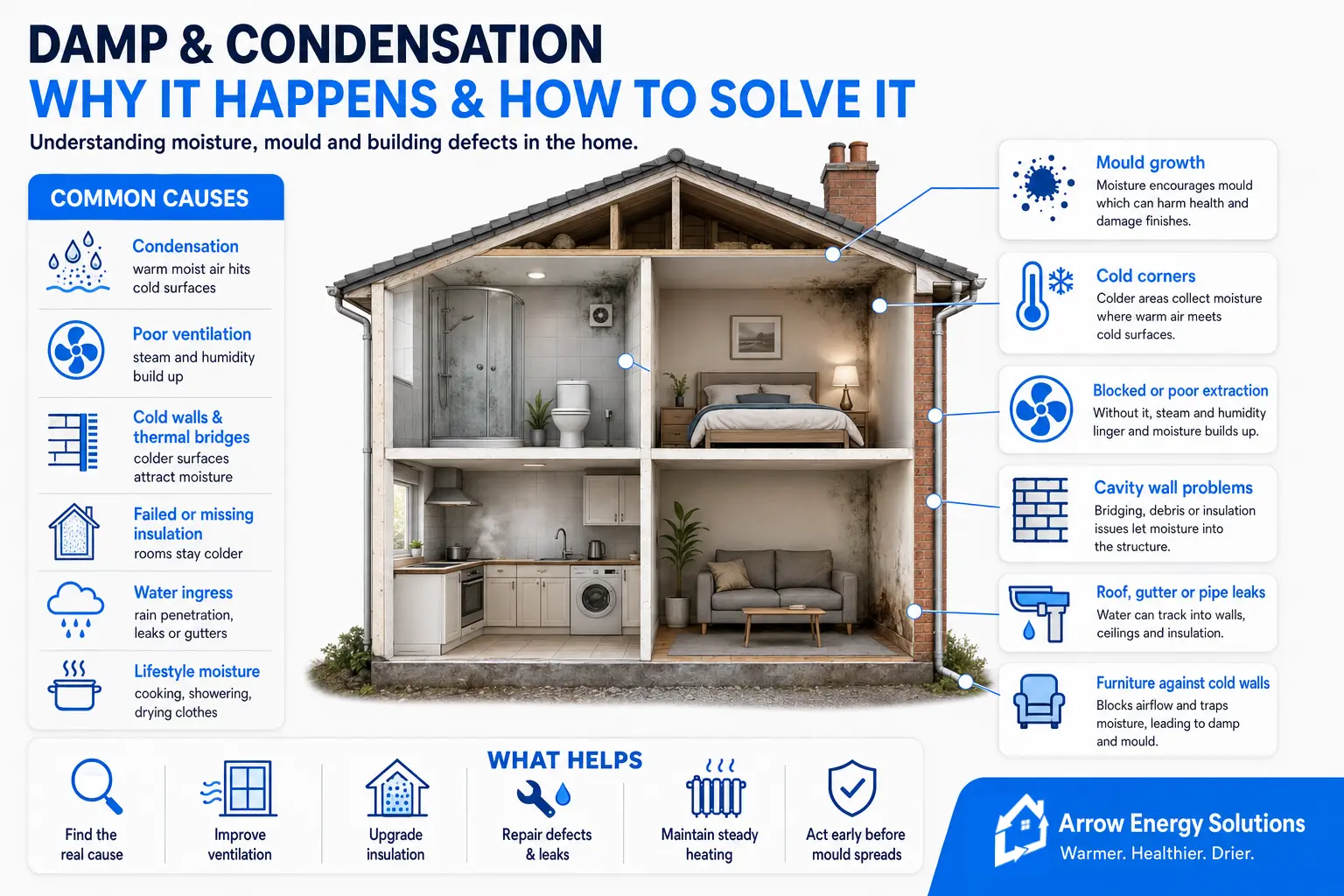
Damp, condensation and mould are often treated as though they are the same problem. Although they can occur together, they may have very different causes and require different solutions.
Cleaning visible mould or repainting a wall may temporarily improve its appearance, but the problem will usually return unless the underlying source of moisture is identified and corrected.
A proper investigation should consider the building fabric, insulation, ventilation, heating and how moisture is being produced and managed within the home.
Air naturally contains moisture in the form of water vapour.
Warm air can hold more moisture than cold air. When warm, moisture-laden air touches a sufficiently cold surface, the air cools and releases some of its moisture as water droplets.
This is condensation.
It commonly appears on:
Windows and window reveals
External walls
Cold corners
Ceilings below loft spaces
Behind wardrobes and large furniture
Around thermal bridges
Inside poorly ventilated bathrooms
In bedrooms overnight
On walls where insulation is missing or uneven
Condensation is often most noticeable during colder months because internal surfaces become colder while windows are kept closed for longer periods.
Normal household activities can introduce significant moisture into the air.
Common sources include:
Showering and bathing
Cooking and boiling water
Drying clothes indoors
Using an unvented tumble dryer
Breathing while sleeping
Mopping floors
Running portable gas heaters
Keeping a large number of plants
Aquariums
Plumbing leaks
Water entering through the building
Moisture production is not necessarily the problem by itself. Difficulties arise when the moisture cannot escape or when internal surfaces are cold enough for condensation to form.
Mould spores occur naturally in the air. They can begin to grow when they settle on a surface that remains damp for long enough.
Condensation frequently creates the conditions mould needs, especially on cold walls, around windows and behind furniture where air circulation is limited.
Mould may appear as black, green, grey or brown spotting and can spread across paint, wallpaper, plaster, sealant, timber and furnishings.
Damp and mould should not be ignored. Government and NHS guidance warns that exposure can affect health, particularly for people with asthma, allergies, respiratory conditions or weakened immune systems, as well as babies, children and older people.
No. Condensation is common, but it is only one possible cause.
A damp investigation should distinguish between several different problems.
Penetrating damp occurs when water enters through the external fabric of the building.
Possible causes include:
Damaged roof tiles
Defective flashing
Cracked render
Failed pointing
Blocked or leaking gutters
Damaged downpipes
Defective window seals
Cracks around openings
Bridged wall cavities
External ground levels that are too high
Penetrating damp often becomes worse after periods of heavy rain.
Leaks from water pipes, waste pipes, heating systems, showers, baths and appliances can create localised damp patches.
Some leaks are hidden beneath floors or inside walls and may remain unnoticed for a considerable time.
Rising damp describes moisture moving upward through porous materials from the ground.
It is less common than condensation and should not be diagnosed simply because a damp patch appears near floor level.
Before recommending chemical damp-proofing or major remedial work, other causes should be ruled out, including:
Plumbing leaks
High external ground levels
Bridged damp-proof courses
Contaminated plaster
Condensation at low-level thermal bridges
Blocked wall cavities
Defective rainwater drainage
A cavity wall is designed to help prevent moisture reaching the internal wall.
However, problems can occur where the cavity contains:
Excessive mortar droppings
Rubble or construction debris
Failed or unsuitable insulation
Insulation that has become saturated
Debris bridging the cavity
Corroded or contaminated wall ties
Water tracking around openings
Defects near trays, lintels or roof junctions
Where damp is suspected to originate within a cavity wall, a borescope inspection can help establish what is happening inside the wall.
Insulation raises the temperature of internal surfaces by slowing the movement of heat through the building.
Warmer internal surfaces are generally less likely to reach the temperature at which condensation forms.
However, insulation must be appropriate for the property and installed correctly.
Problems can occur where insulation is:
Missing from sections of the wall
Unevenly distributed
Slumped or deteriorated
Incorrectly installed
Obstructed by debris
Exposed to persistent water penetration
Installed without considering ventilation
Partial or failed insulation may create cold spots where condensation becomes concentrated.
This is why visible mould should not automatically be blamed on occupant behaviour. The condition of the building must also be investigated.
Ventilation removes moisture-laden indoor air and replaces it with fresher air.
Useful ventilation measures may include:
Working bathroom extractor fans
Effective kitchen extraction
Open trickle vents
Background ventilation
Brief, controlled window opening
Suitable whole-house ventilation
Keeping air paths around furniture
Closing bathroom and kitchen doors while moisture is being produced
Extractor fans should discharge outside the property rather than into a loft, ceiling void or wall cavity.
Ventilation should not mean leaving the home cold all day. The objective is controlled moisture removal while maintaining reasonable internal temperatures.
Government and local-authority guidance commonly recommends combining ventilation, suitable heating and moisture control rather than relying on a single measure.
Cold homes are generally more vulnerable to condensation because their walls, ceilings and windows remain at lower temperatures.
Steady background heating can be more effective than allowing a property to become extremely cold and then heating it intensely for a short period.
Heating alone will not resolve a leak, blocked cavity or failed insulation. However, suitable heating can help keep internal surfaces above the temperature at which condensation forms.
Practical measures include:
Use extractor fans while cooking and showering
Keep bathroom and kitchen doors closed during moisture-producing activities
Avoid drying washing on radiators
Dry clothes outdoors or in a properly ventilated space where possible
Vent tumble dryers externally where required
Keep trickle vents open
Wipe excessive window condensation
Leave space behind furniture on external walls
Avoid overfilling wardrobes
Use pan lids when cooking
Maintain a reasonable and relatively consistent indoor temperature
Investigate leaks and building defects promptly
Check loft and cavity wall insulation
These steps may improve normal household condensation, but persistent damp, widespread mould or recurring water staining should be professionally investigated.
Mould-removal products can remove or kill surface growth, but they do not necessarily address the moisture source.
The mould may return because:
The wall remains cold
Humidity remains too high
Ventilation is inadequate
Insulation is missing or defective
Water is penetrating from outside
A leak remains unresolved
Furniture is preventing air movement
The cavity contains debris or failed insulation
Anti-mould paint can provide additional protection after the source has been addressed, but it should not be treated as a substitute for fixing the underlying problem.
A professional assessment may include:
A visual inspection inside and outside
Moisture readings
Humidity and temperature measurements
Dew-point assessment
Thermal imaging
Cavity wall borescope inspection
Loft inspection
Inspection of gutters, roofs and rainwater goods
Checking ventilation and extractor fans
Identifying insulation gaps
Reviewing the pattern and timing of the damp
No single moisture-meter reading should be relied upon to diagnose every type of damp. The location, weather conditions, construction and history of the property all need to be considered.
The correct solution depends entirely on the cause.
It may involve:
Repairing a roof, gutter or downpipe
Resolving a plumbing leak
Improving extraction or ventilation
Upgrading loft insulation
Installing suitable cavity wall insulation
Removing failed cavity insulation
Clearing cavity debris
Improving heating controls
Correcting external ground levels
Repairing damaged render or pointing
Treating and redecorating affected surfaces after they have dried
Installing insulation without repairing water penetration can make matters worse. Equally, removing insulation will not resolve condensation caused solely by inadequate ventilation and heating.
Arrow Energy Solutions provides professional damp, insulation and cavity wall investigations throughout the South of England.
Our surveyors can inspect the property, investigate the wall cavity and help distinguish between condensation, building defects and failed insulation.