
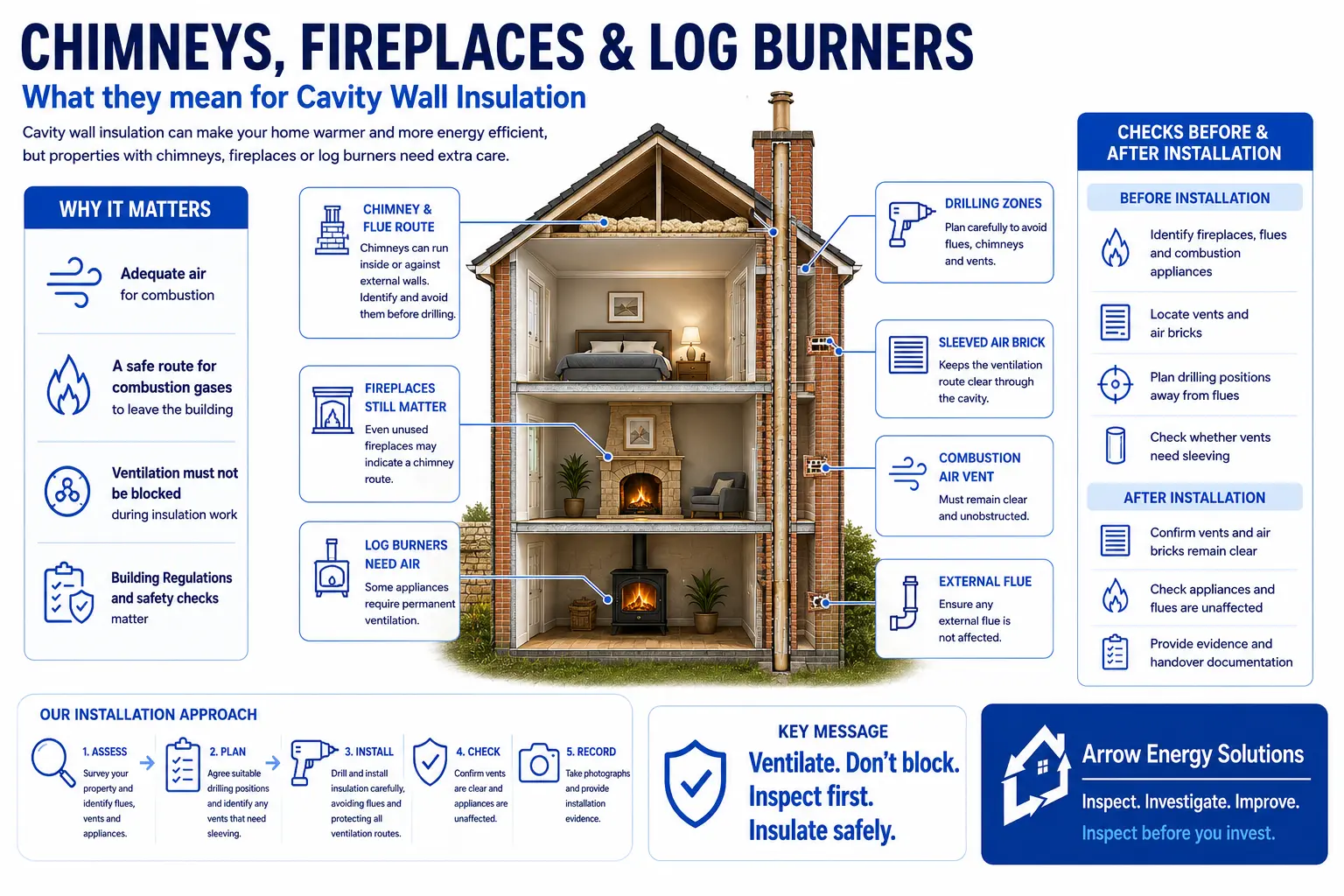
Cavity wall insulation can make a home warmer and more energy efficient, but properties containing fireplaces, log burners, chimneys or other combustion appliances require additional care.
These features rely on the safe movement of air and combustion gases.
Before cavity wall insulation is installed, the location and condition of relevant flues, chimneys and ventilation openings should therefore be identified and checked.
This is an important part of ensuring that insulation work does not interfere with the safe operation of the property.
A fire or combustion appliance needs two things to operate safely:
An adequate supply of air for combustion
A safe route for combustion gases to leave the building
Depending on the property, these may involve:
Chimneys
Flue liners
External flues
Air vents
Air bricks
Purpose-provided combustion ventilation
Building Regulations guidance under Approved Document J specifically covers air supply, combustion products, fireplaces, flues and chimneys.
Cavity wall insulation work therefore needs to take these components into account.
Chimneys are commonly built into or against external walls.
This means sections of the chimney or flue may run close to areas where cavity wall insulation is being injected.
Before drilling takes place, installers need to understand where flues and chimney routes are located.
The objective is to avoid:
Drilling into a chimney or flue
Damaging the flue system
Allowing insulation material to enter an inappropriate area
Obstructing ventilation associated with the appliance
What is visible inside the room does not necessarily show the entire route of the chimney or flue.
Older homes may contain open fireplaces even if they are rarely used.
Some fireplaces may also have been:
Closed off
Partially removed
Converted to gas
Converted to a log burner
Reopened after many years
The presence of a chimney breast can therefore require further investigation even when the original fireplace is no longer obvious.
Where a fireplace or chimney remains in use, its ventilation and flue arrangements should be considered as part of the insulation assessment.
Log burners have become increasingly common in UK homes.
Unlike a sealed heating system, a log burner requires combustion air and relies upon its flue or chimney to safely remove combustion products.
Some installations require permanent ventilation specifically for the appliance.
Government guidance also makes clear that where an open-flued appliance is present, permanent combustion-air ventilation may be required independently of the property’s normal background ventilation.
These ventilation openings must not simply be covered, filled or obstructed during insulation work.
One of the most important checks during cavity wall insulation is identifying the purpose of air vents and air bricks.
They may provide ventilation for:
Combustion appliances
Suspended timber floors
Rooms
Under-floor voids
Other parts of the building
Where a ventilation opening passes through a cavity wall, the route may need to remain isolated from the insulation.
Depending on the construction and system requirements, this can involve correctly sleeving the opening through the cavity.
The important principle is that insulation should not be allowed to block or compromise an essential ventilation path.
An air brick visible on the outside of a house does not necessarily form a sealed passage through the cavity.
If insulation is introduced around an unprotected opening, material may enter or partially obstruct the ventilation route.
Where required, a suitable sleeve creates a defined passage through the cavity so that airflow can continue without insulation entering the opening.
This is why vents and air bricks should be identified before installation rather than discovered afterwards.
A professional cavity wall insulation assessment should consider the presence of combustion appliances and their associated ventilation and flue arrangements.
Depending on the property, checks may include:
Identifying fireplaces and combustion appliances
Confirming fuel type
Identifying chimney and flue routes
Locating combustion-air vents
Checking external flues
Identifying air bricks and ventilation openings
Assessing whether vents require protection or sleeving
Recording relevant conditions before work begins
If there is uncertainty about the safety of an appliance or flue, the appropriate competent specialist should be involved.
Installers also need to remain aware of flues and ventilation routes while drilling and injecting insulation.
Drilling positions should be planned to avoid known flues and chimney routes.
Where ventilation openings pass through the cavity, the installer should make sure they remain clear and functional.
Cavity wall insulation is largely hidden after installation, which makes careful preparation particularly important.
Where appropriate, relevant checks should be repeated after cavity wall insulation has been installed.
The purpose is to confirm that the work has not adversely affected the operation of the combustion appliance, flue or ventilation provision.
The exact checks required depend upon the appliance and circumstances.
If a potential safety issue is identified, the appliance should not simply continue to be used without appropriate investigation by a competent person.
An unused chimney does not automatically mean there is nothing to consider.
A chimney may have been capped externally, blocked internally or simply not used by the current homeowner.
Changes to ventilation can sometimes create moisture issues within redundant chimney structures.
Its construction and condition may therefore still be relevant when assessing the property.
Cavity wall insulation can provide a valuable improvement to a suitable property.
But improving energy efficiency must never interfere with:
Combustion air
Flue performance
Chimney safety
Essential ventilation
The safest approach is to identify these features before work begins and ensure they remain properly protected throughout the installation.
At Arrow Energy Solutions, cavity wall insulation is not treated simply as filling an empty wall.
The property must first be assessed for suitability and features that could affect the installation need to be identified.
Where fireplaces, chimneys, log burners or other combustion appliances are present, our installation process includes consideration of the associated flues and ventilation arrangements.
Our services include:
Cavity wall surveys
Borescope inspections
Cavity wall insulation
Existing insulation assessment
Insulation extraction
Photographic installation evidence
Installation and handover documentation
A chimney, fireplace or air vent may occupy only a small part of a wall, but it can have an important safety function.
Good cavity wall insulation work therefore involves more than improving thermal performance.
It means understanding the property, identifying potential risks and ensuring that essential ventilation and combustion systems continue to operate as intended.