
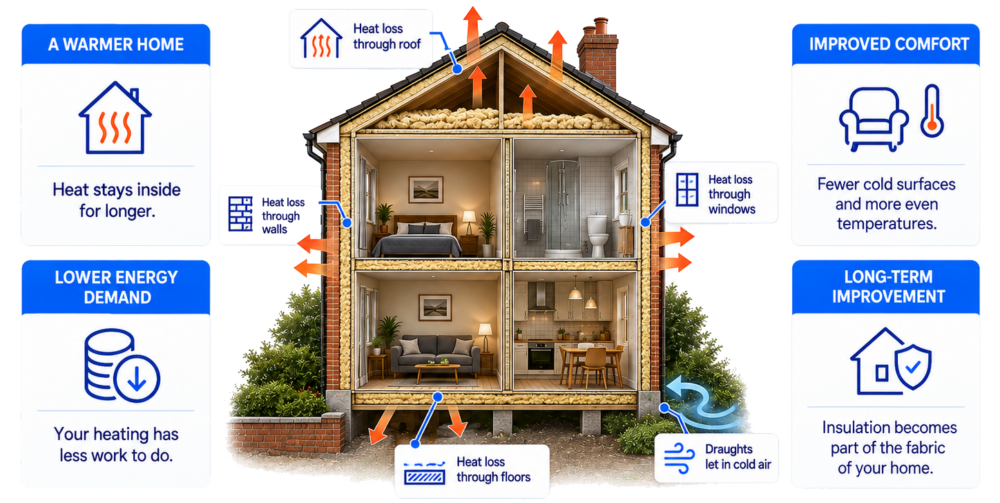
An uninsulated cavity wall can allow a substantial amount of heat to escape from your home. Installing cavity wall insulation helps slow this heat loss, making the property easier to heat and helping rooms maintain a more comfortable temperature.
Arrow Energy Solutions provides professional cavity wall insulation for private homeowners throughout the South of England. We install high-quality EPS bonded bead insulation, subject to a detailed survey confirming that the property and cavity are suitable.
Every property is different. Before recommending insulation, we assess the construction, condition and exposure of the building to ensure the proposed installation is appropriate.
EPS bonded bead insulation consists of small expanded polystyrene beads that are injected into the wall cavity through a carefully planned pattern of drilled holes.
A specially formulated adhesive is introduced during installation, bonding the beads together within the cavity. This creates a stable and consistent layer of insulation while allowing the material to flow around wall ties and other minor obstructions.
Once installed correctly, the bonded bead forms a continuous insulating layer that helps reduce heat loss through the external walls
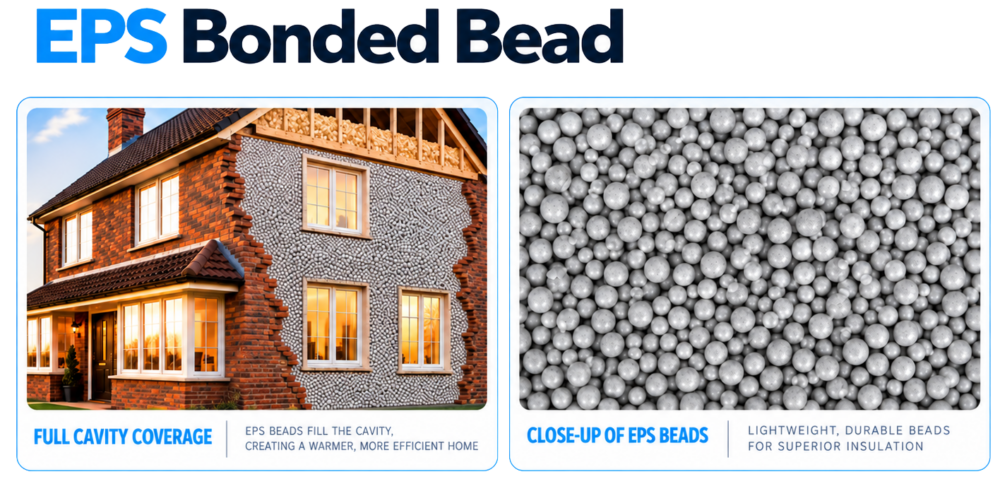
We use EPS bonded bead because it provides an effective and reliable method of insulating suitable cavity walls.
The benefits of bonded bead insulation include:
The bead system can often achieve a more consistent fill than older loose-fill materials because the small beads move freely through the cavity and are bonded together during installation.
Professionally installed cavity wall insulation can:
The exact improvement will depend on the size, age, construction and existing condition of the property, together with how the home is heated and used.
Not every property is suitable for cavity wall insulation. A detailed survey must be completed before work is recommended.
The property will normally require:
Properties with severe damp, defective pointing, damaged render, leaking gutters, roof defects or heavily contaminated cavities may require remedial work before insulation can be considered.
Some forms of construction, including certain steel-framed, timber-framed, system-built or non-traditional properties, may not be suitable for standard cavity wall insulation.
Before providing a quotation, our surveyor will inspect the property and assess whether the walls are suitable for EPS bonded bead insulation.
The survey may include checks of:
Inspection holes may be drilled in discreet locations so that the cavity can be examined using a borescope. This helps us identify existing insulation, debris, wall ties and other conditions that may affect the installation.
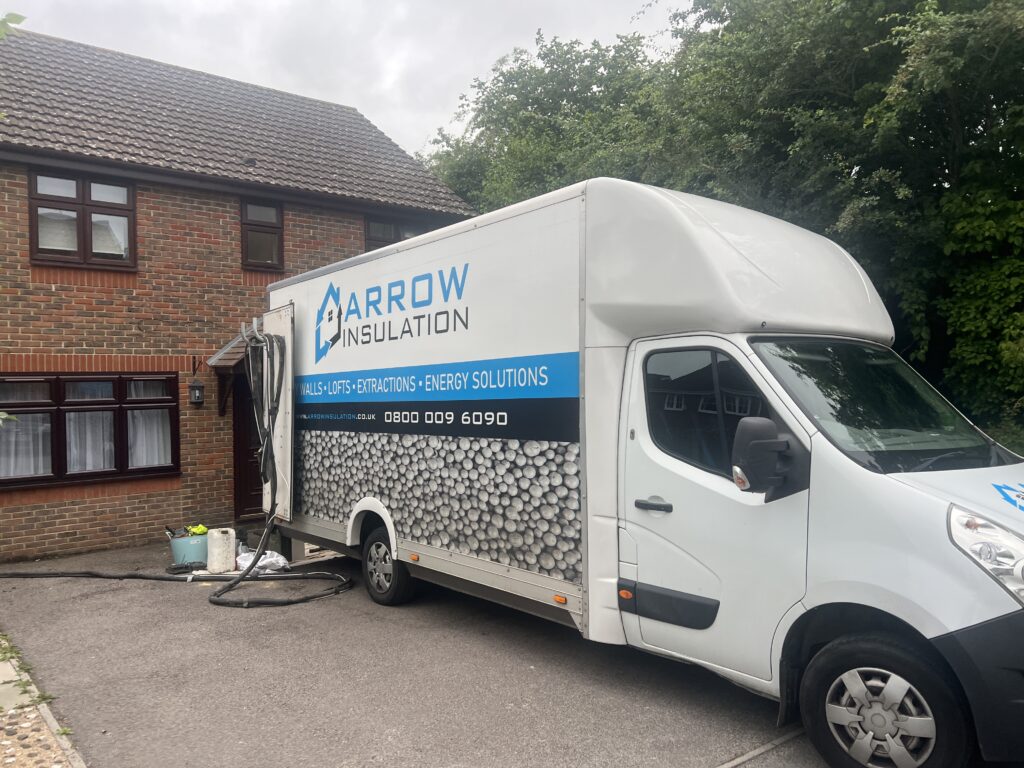
EPS bonded bead is normally installed from outside the property, reducing disruption inside the home.
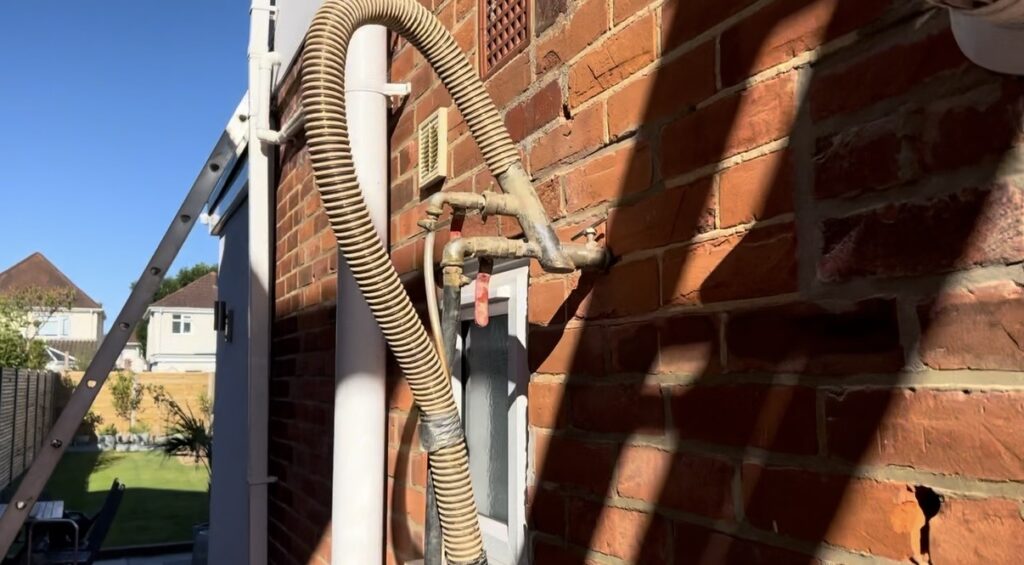
Our installers drill a series of small holes through the outer wall in accordance with the approved drilling pattern for the property and insulation system.
The bonded bead is then injected into the cavity using specialist equipment. The material is installed in a controlled sequence to achieve a complete and consistent fill.
Once the installation has been completed, the drill holes are made good using mortar or a suitable finishing material selected to provide the closest practical match to the existing wall.
The principal stages are:
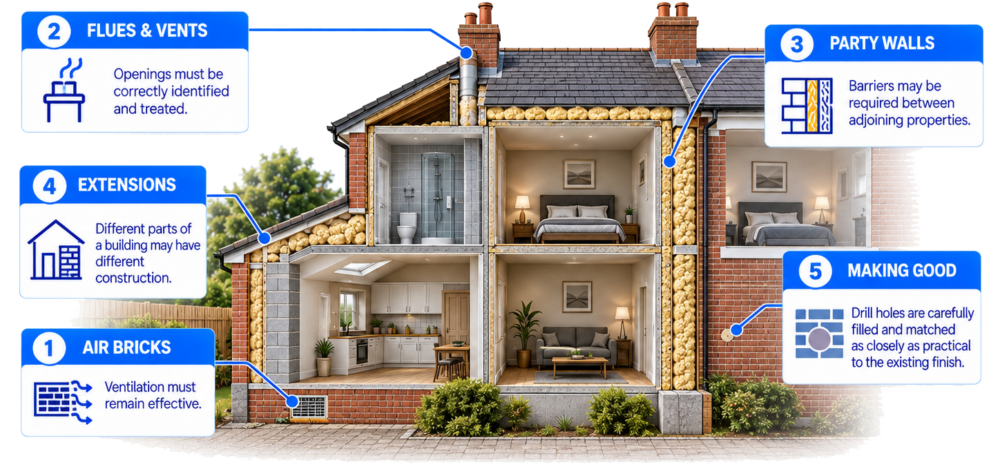
Special care is required where the property contains gas appliances, open fires, wood-burning stoves, oil-fired appliances or other combustion systems.
The location and type of flue must be considered before insulation is installed. Certain flues may require clearances, barriers or further inspection by a suitably qualified heating engineer.
Where there is uncertainty about an appliance, flue or ventilation requirement, the issue should be resolved before the cavity wall insulation proceeds.
Before installation, problems such as defective pointing, cracked render, overflowing gutters, leaking downpipes, roof leaks and raised external ground levels should be repaired.
Where a wall is already affected by penetrating damp, installing insulation without first correcting the source may make diagnosis and future remedial work more difficult.
Our survey will identify visible concerns, but concealed defects may only become apparent when inspection holes are drilled or work begins. Where we find a significant issue, we will explain the problem and advise on the next steps.
Conservatories, extensions, garages, porches, lean-to roofs and adjoining buildings can restrict access to sections of the external wall.
In some cases, internal drilling may be required to reach otherwise inaccessible areas. This will be discussed with the homeowner before work begins.
Where a section cannot be safely or effectively accessed, it may need to be excluded from the installation. We will explain any limitations identified during the survey and show them clearly within our quotation.
Following installation, the drill holes are filled using a mortar or suitable finishing material chosen to provide the closest practical match to the existing wall.
Because mortar, brickwork and render change colour with age and weathering, it may not be possible to create an invisible repair. Newly filled holes can initially appear lighter or darker than the surrounding surface but will often become less noticeable as they weather.
Special finishes, painted render, decorative coatings, tile hanging or unusual brickwork may require additional consideration before installation.
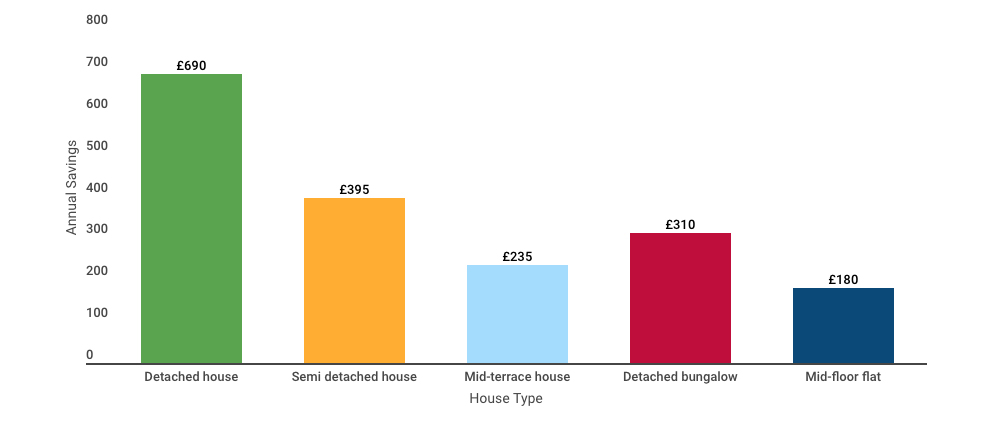
The below estimates of typcial savings are provided by the Energy Saving Trust
These have been based on gas heated homes with fuel prices as of October 2022.
The below estimates are provided by the Energy Saving Trust show the typical Carbon Dioxide savings (kgCO2/year)
A party wall is the shared wall between two adjoining homes, such as semi-detached or terraced properties.
Even though it is not an external wall, an uninsulated party wall can still allow heat to move between properties and may contribute to draughts, noise transfer and uneven temperatures.
Installing EPS bonded-bead insulation within a suitable party-wall cavity can help:
Before any work is carried out, the wall should be inspected to confirm its construction, cavity condition and suitability for insulation.
Arrow Energy Solutions provides professional party-wall surveys and bonded-bead insulation throughout the South of England.

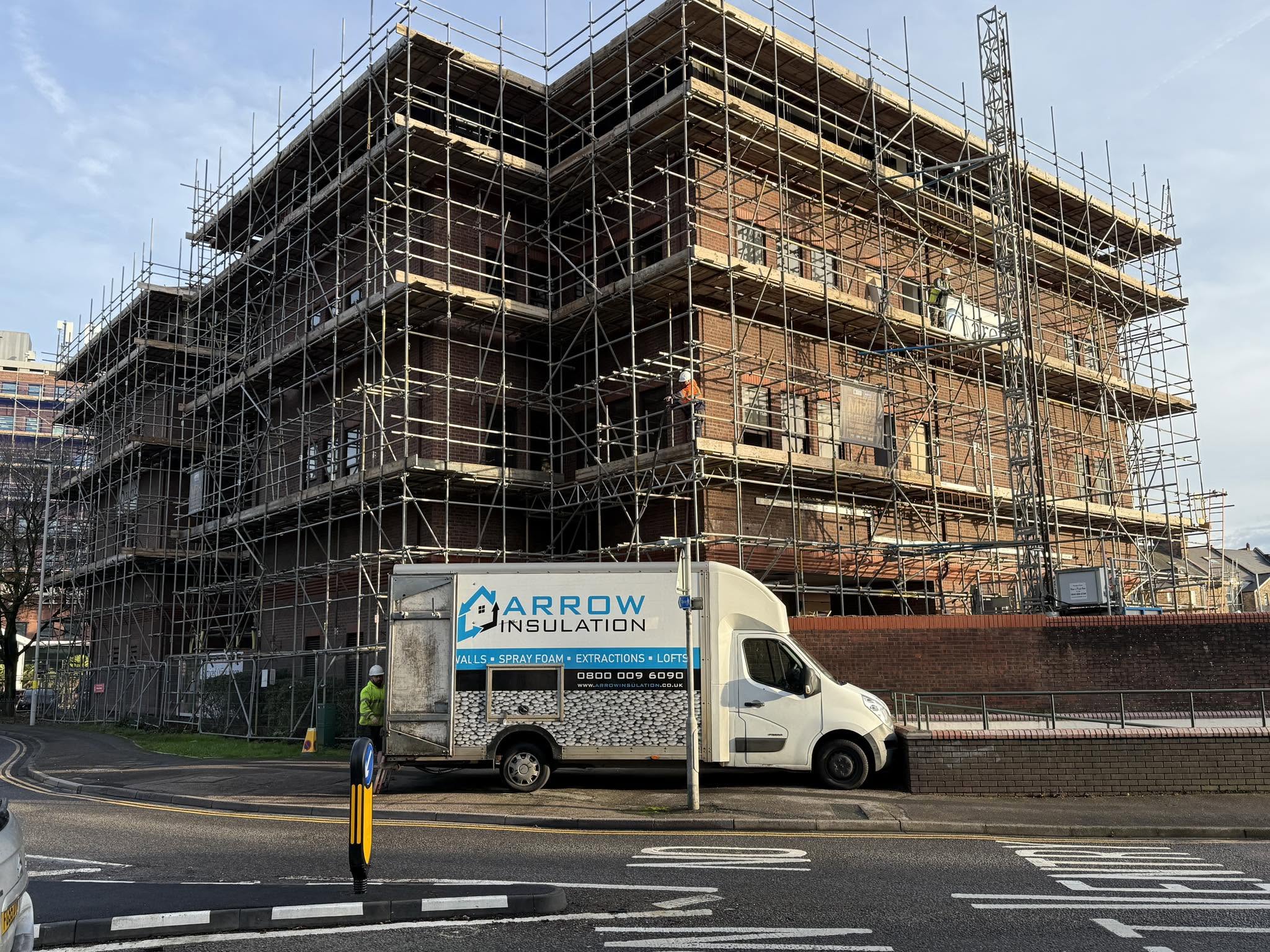
We can offer cavity wall insulation for commercial and public-sector buildings, helping improve thermal performance, reduce heat loss and lower ongoing energy costs.
Our experienced teams have completed insulation works across a wide range of properties, including universities, hospitals, factories, warehouses and office buildings.
We use EPS bonded bead cavity wall insulation, providing an effective and durable solution that can be installed with minimal disruption to the day-to-day operation of the building.
We have performed installs for:
From initial survey and assessment through to installation and completion documentation, we can manage the works as part of a single building project or a larger multi-site programme.
Many houses since 1900’s were built with a cavity between the inner and outer walls. Due to this cavity, many of Britain’s homes have thermal performances which are well below the standards required by current building regulations, with unacceptably high levels of heat and energy loss through the walls.
Cavity wall insulation is suitable for houses which have a cavity space of at least 40mm between the two brick/block walls. Unfortunately timber framed, steel framed, random stone and solid wall properties are not suitable for cavity wall insulation.
The EPS Bonded Bead product is an innovative cavity wall insulation material that provides an extremely high level of thermal wall efficiency. The system is both BBA and KIWA certified and has quickly gained a reputation throughout the UK as the best and most trusted insulation systems yet seen for cavity wall installations.
EPS bonded bead insulation is ideal for domestic, commercial and industrial use. Due to the drill pattern, air pressure and the nature of the bead we can provide 100% cavity fill with no cold spots, no waste and easy to install. EPS has outstanding durability, it is water resistant and wont break down until it is recycled again.

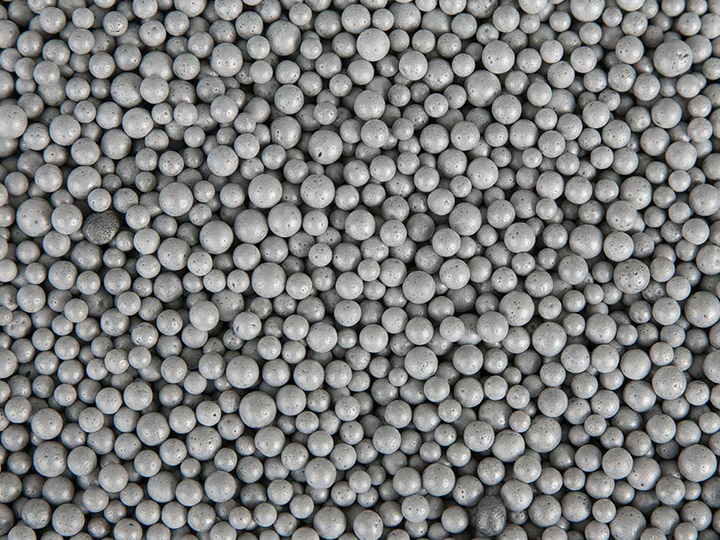
EPS cavity wall insulation is the reassuringly familiar EPS (expanded polystyrene) bead. EPS has outstanding insulating properties and is currently used in many different forms in the construction sector. Selecting Evobead is a good choice for the environment because:
Everything you need to know before booking your free survey and quotation.
Not long. For example, it takes between two and three hours to install cavity wall insulation in a three bedroom semi-detached house.
No. The insulation is injected from the outside, so the installers will not be working in your property. And our installers always make sure they leave the outside of your property in a clean and tidy condition.
No. We have specialist safety and access equipment that was designed for use on hard to access properties.
EPS Bonded Bead are an expanded polysterryn. They can be recycled and have come from recycled material already. They wont however, break down, rot, distort, absorb moisture or crush under its own weight. Thus as long as the bead does not get disturbed in the cavity space such as knocking a wall out, it should last the life time of the home.
These are estimated figures published by the Energy Saving Trust. Estimates based on a gas-heated home. The average install cost is unsubsidised. Figures are based on fuel prices as of October 2022. As you can see, the investment pays for itself in about three years. For larger homes, or those heated by electricity or oil, the savings will be significantly higher. As energy prices rise the return will be quicker. Detached house should save £690 a year Semi detached house should save £395 a year Mid-terrace house should save £235 a year Detached bungalow should save £310 a year
Please do remember the team work hard outside all day and a may wish to use the facilities and I am sure the offer of a cup on a cold day would be most welcome.