
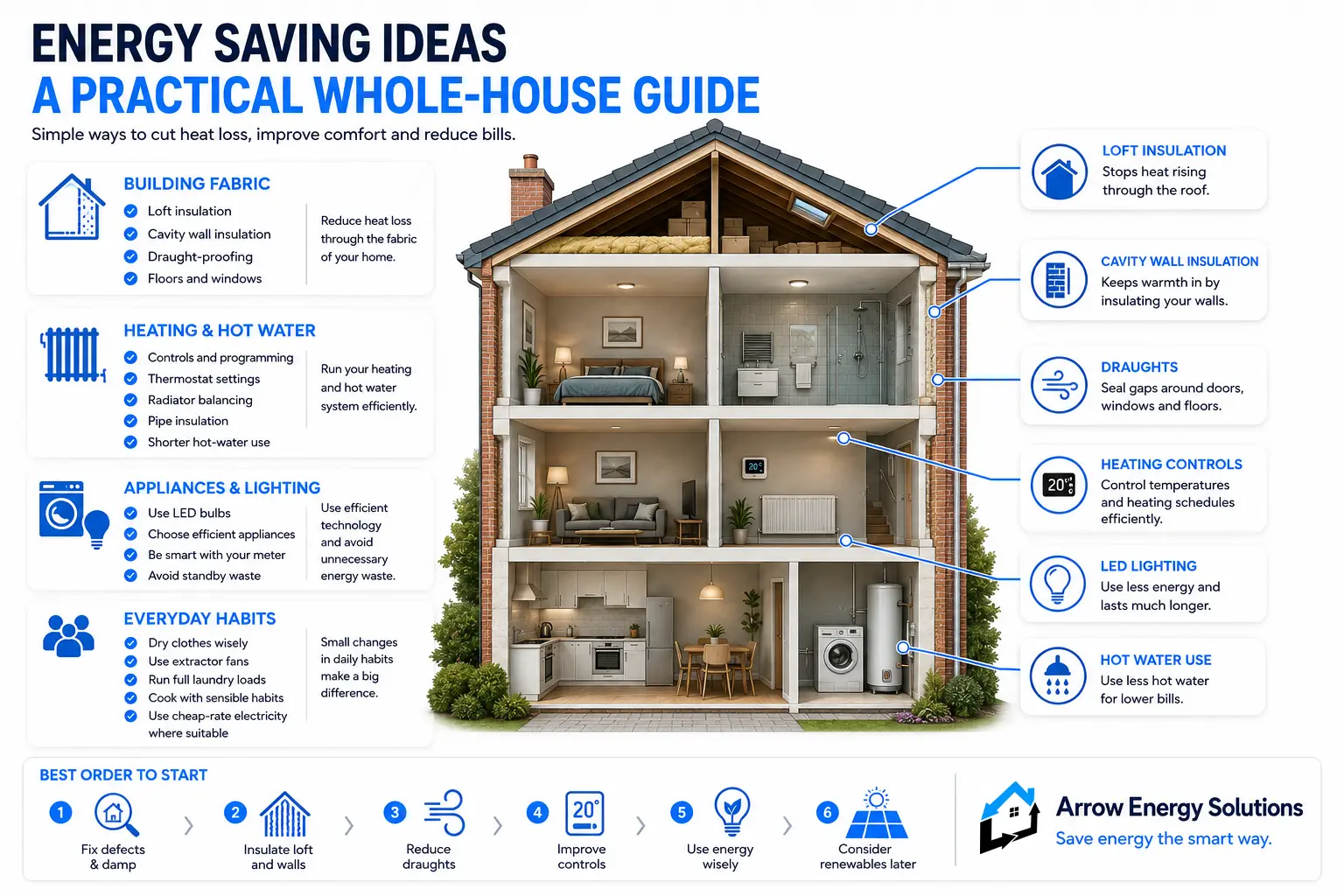
Reducing energy use is not about buying one gadget or making one dramatic lifestyle change.
The best results usually come from combining improvements to the building itself with efficient heating, sensible appliance use and straightforward everyday habits.
Some changes require professional investment. Others cost very little and can be introduced immediately.
This guide divides home energy efficiency into four areas:
Before paying to produce heat, it makes sense to reduce how quickly that heat escapes.
The walls, roof, floors, windows and doors form the building fabric. Improving these areas can reduce heating demand and make the home feel warmer at a lower thermostat setting.
A significant amount of heat can be lost through uninsulated external walls.
Properties with suitable cavity walls may benefit from professionally installed cavity wall insulation. Modern bonded-bead systems fill the available cavity with insulating polystyrene beads held together with an adhesive.
Before installation, the walls should be surveyed to confirm that the cavity is suitable and free from defects, excessive debris or unsuitable existing material.
Older insulation should also be inspected. Failed foam, fibre or wool insulation may need to be removed before a replacement system can be installed.
Heat naturally rises, making the loft one of the most important areas of the home to insulate.
Where accessible and appropriate, mineral-wool loft insulation is commonly installed to a total depth of approximately 270mm. The exact specification may depend on the product, existing insulation and construction of the property.
Insulation should be installed evenly without blocking required ventilation at the eaves. Water tanks, pipework, electrical fittings, walkways and loft storage must also be considered.
Uncontrolled draughts allow warmed air to escape and cold air to enter.
Common draught locations include:
Purpose-provided ventilation should not be permanently blocked. Air bricks, extractor fans, trickle vents and combustion ventilation may be necessary for safety and moisture control.
Suspended timber floors can sometimes be insulated from below, helping reduce cold floors and unwanted air movement.
Modern glazing and well-sealed doors may also improve comfort. However, window replacement is not always the first or most cost-effective energy measure, particularly when the loft and walls remain poorly insulated.
The property should be considered as a complete system rather than as a collection of unrelated products.
Heating and hot water account for a substantial proportion of household energy consumption.
Improving how the system is controlled can therefore produce meaningful savings.
A suitable control system may include:
Controls should reflect how the household actually uses the property. Heating empty rooms or maintaining high temperatures overnight will increase consumption unnecessarily.
Reducing the thermostat slightly can lower energy demand, but comfort, age and health must always be considered.
Rather than allowing the property to become extremely cold, aim for a stable and comfortable temperature while avoiding unnecessary overheating.
Rooms that are rarely occupied can often be maintained at a lower temperature, provided this does not create condensation or damp problems.
A poorly maintained system may use more energy than necessary.
Useful checks include:
Heating-system changes should be completed by a suitably qualified professional.
Hot water requires energy whether it is produced by gas, oil, electricity or a heat pump.
Simple ways to reduce demand include:
Hot-water temperatures must still be managed safely to control the risk of harmful bacteria.
Energy-saving technology can be helpful, but it should support good energy management rather than distract from the fundamentals.
LED bulbs use considerably less electricity than traditional incandescent or halogen lighting and generally last much longer.
Focus first on the lights used for the greatest number of hours each day.
When replacing an appliance, consider its estimated annual energy use rather than looking only at the purchase price.
A cheaper appliance that consumes more electricity throughout its life may ultimately cost more.
Pay particular attention to frequently used or continuously operating appliances such as:
A smart meter or energy-monitoring device can help identify when electricity is being used and highlight unusually high consumption.
The display does not save energy by itself. Its value comes from helping the household identify avoidable use and measure whether changes are working.
Smart controls can make it easier to adjust heating schedules, manage zones and avoid heating an empty property.
However, a smart thermostat cannot overcome poor insulation, an incorrectly designed heating system or unsuitable user settings.
Solar photovoltaic panels generate electricity during daylight hours.
Battery storage can retain some of this electricity for later use or charge from the grid during cheaper tariff periods. Whether the investment is worthwhile depends on:
The system should be properly modelled around the household’s real consumption rather than sold on headline savings alone.
Not every product marketed as an energy saver will reduce household bills.
Devices claiming to dramatically cut electricity consumption simply by being plugged into a socket should be treated with caution.
Prioritise proven measures such as insulation, heating controls, efficient appliances, LED lighting and sensible tariff management.
Lifestyle changes are most effective when they are simple enough to maintain.
Many modern appliances use relatively little energy in standby mode, but consumption across numerous devices can still add up.
Switch off equipment that does not need to remain active, particularly older televisions, office equipment, games consoles, audio equipment and chargers.
Do not switch off devices that require continuous power for safety, security, medical or essential communication purposes.
Time-of-use tariffs can reward households for moving electricity consumption away from peak periods.
Dishwashers, washing machines, electric vehicles and batteries may be scheduled for cheaper hours where it is safe to do so.
High-powered appliances should not be left operating unattended unless the manufacturer confirms that this is appropriate.
Start by identifying the areas that use or lose the most energy.
A sensible order is often:
The right order may differ for each property, particularly where major renovation or a heat-pump installation is planned.
The cheapest unit of energy is usually the one the property does not need to consume.
Reducing heat loss can improve comfort every day, regardless of whether the home is heated by gas, oil, electricity or a heat pump.
Arrow Energy Solutions provides cavity wall surveys, cavity insulation extraction, bonded-bead cavity wall insulation and loft insulation throughout the South of England.