
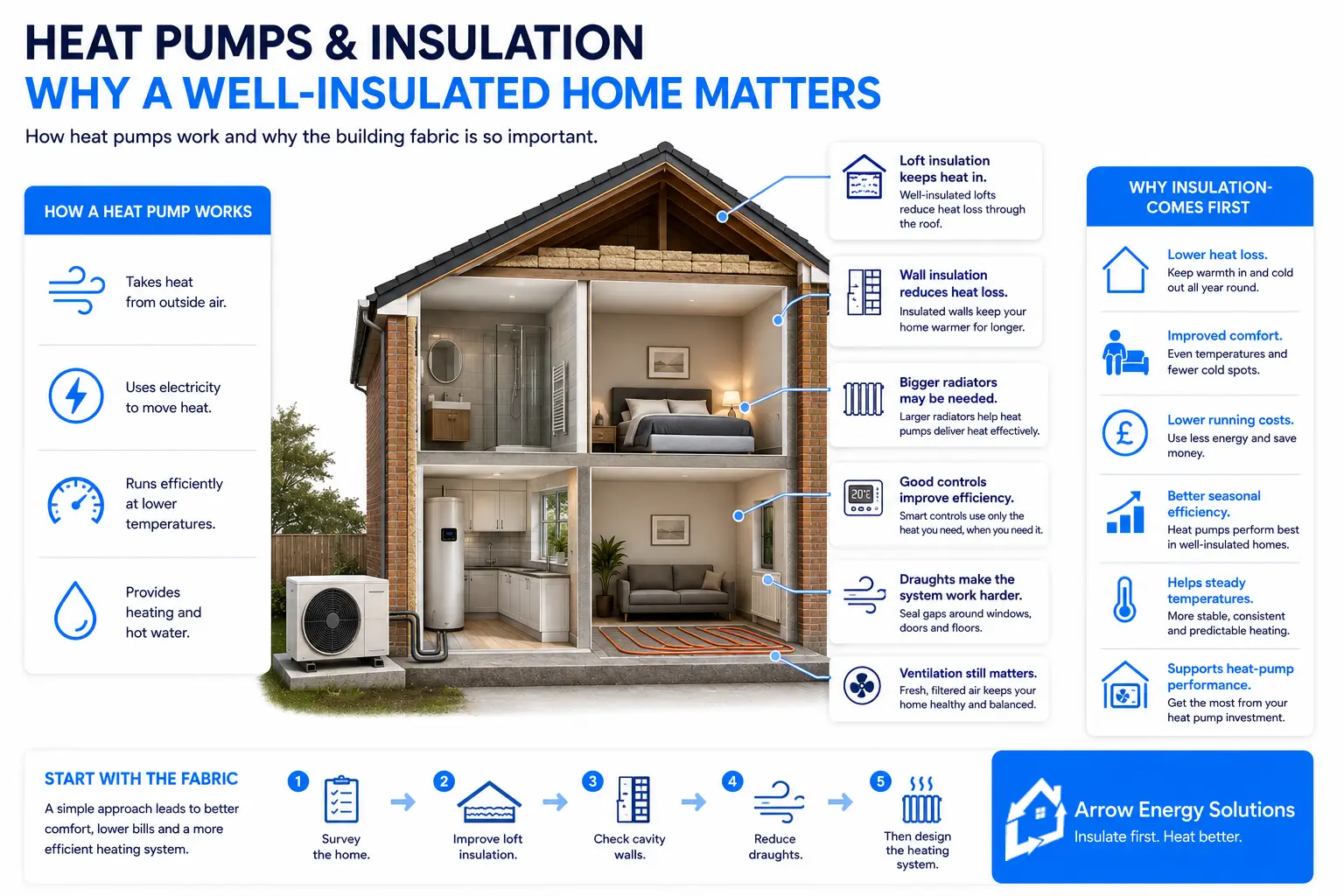
Heat pumps can provide an efficient, lower-carbon way to heat a home. However, the performance of a heat pump depends heavily on the property in which it is installed.
A heat pump cannot compensate efficiently for a home that continually loses heat through its walls, roof, floors, windows and uncontrolled draughts.
Before investing in a new heating system, homeowners should therefore consider the condition of the building fabric and identify where heat may be escaping.
A heat pump does not create heat in the same way as a conventional gas or oil boiler.
Instead, it collects naturally occurring heat from outside the property and transfers it into the home.
An air source heat pump extracts heat from the outside air. A ground source heat pump collects heat through pipes installed beneath the ground.
The system uses electricity to operate a refrigerant cycle. The refrigerant absorbs heat, is compressed to increase its temperature and then transfers that heat into the home’s heating and hot-water system.
A well-designed heat pump can typically deliver several units of heat for each unit of electricity it consumes. This is why heat pumps can be much more efficient than direct electric heating.
A traditional boiler commonly sends relatively high-temperature water around the heating system. This allows radiators to become very hot and heat rooms quickly.
Heat pumps are usually most efficient when operating for longer periods at lower flow temperatures.
Rather than repeatedly producing short bursts of intense heat, a heat pump is designed to maintain a steady and comfortable indoor temperature.
This approach works well when the property retains heat. It becomes less effective when heat is escaping faster than the system can replace it economically.
The heating system must replace the heat that a building loses.
A poorly insulated home may lose heat through:
The greater the heat loss, the larger the heat pump may need to be and the harder it must work during cold weather.
Reducing heat loss can help:
Insulation does not generate heat. It slows down the rate at which valuable heat escapes.
A property does not have to meet new-build standards before a heat pump can be installed.
Heat pumps can work successfully in many older homes, provided that the system has been designed around an accurate assessment of the property’s heat loss.
However, improving practical areas of insulation before or alongside the heat-pump installation can make the system more efficient and affordable to operate.
The most appropriate improvements will depend on the construction of the property.
These may include:
Ventilation must also be considered whenever insulation or airtightness is improved. A warmer, more airtight home still needs controlled ventilation to manage moisture and maintain healthy indoor air quality.
Because heat pumps generally operate at lower water temperatures, some properties require larger radiators or additional heat emitters.
A larger radiator has a greater surface area, allowing it to deliver the required amount of heat without the water needing to be as hot.
Underfloor heating can also work effectively with a heat pump, although it is not essential.
The correct solution should be determined through a detailed room-by-room heat-loss calculation rather than guesswork.
Ideally, the final insulation specification should be understood before the heat pump is designed.
This enables the heating engineer to calculate the home’s expected heat loss after the planned improvements have been completed.
Installing a heat pump based on the current condition of an inefficient property and insulating it later may result in an unnecessarily large system. Conversely, sizing a heat pump on the assumption that insulation will be installed, and then failing to complete those improvements, may leave the system unable to heat the property efficiently.
The insulation and heating designs should therefore be coordinated.
A heat pump is only one part of an energy-efficient home.
Before changing the way a property is heated, it makes sense to understand how effectively the building retains that heat.
Arrow Energy Solutions provides cavity wall surveys, cavity wall insulation, failed-insulation extraction and loft-insulation services across the South of England.
We help homeowners improve the building fabric before investing in a new heating system.