
A damp patch on a wall can have several completely different causes.
Two properties can show very similar symptoms while requiring completely different repairs.
That is why diagnosing damp based only on appearance can be misleading.
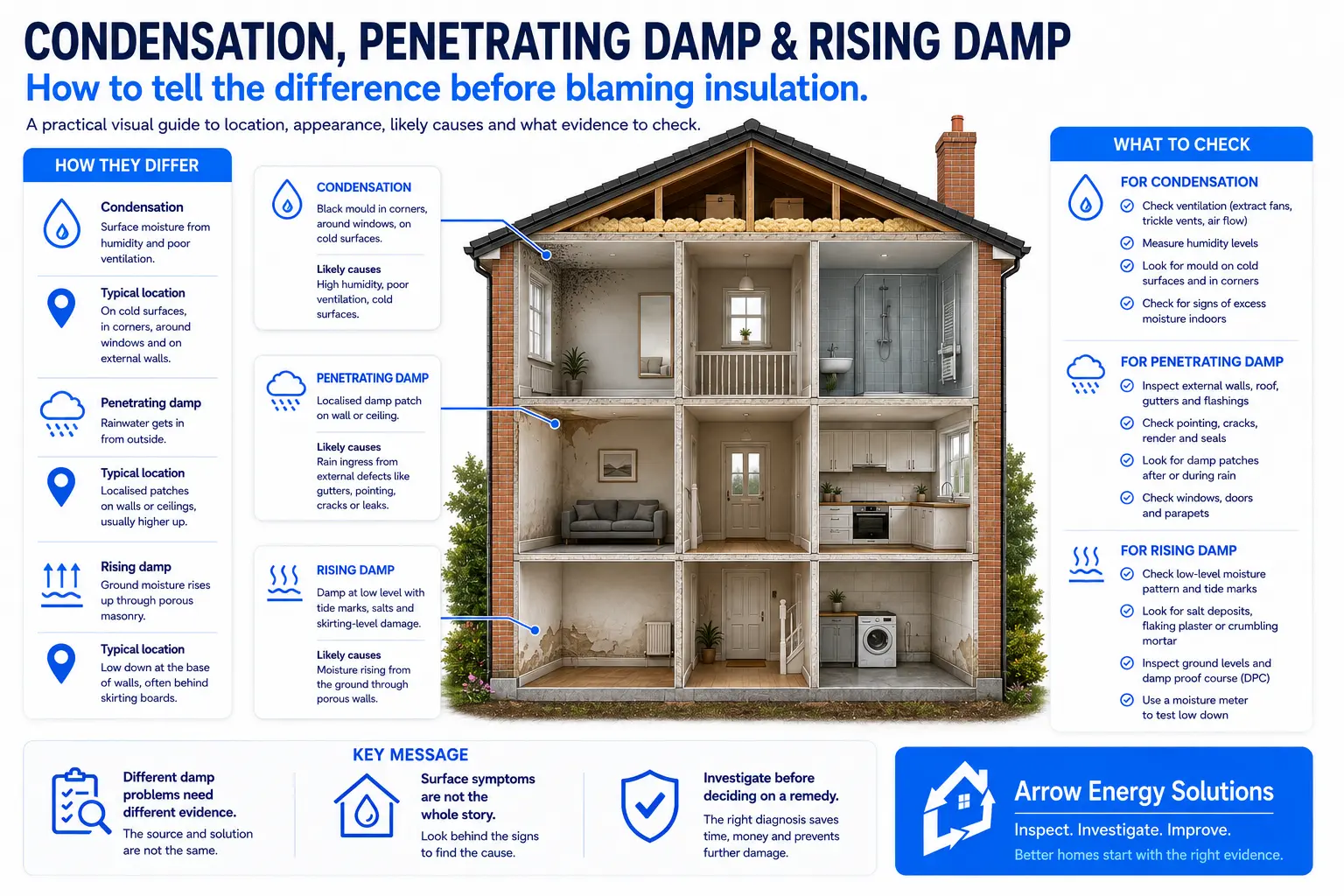
Three terms are commonly used when discussing damp in homes:
Understanding the differences can help identify what evidence should be gathered before deciding on a remedy.
It is also particularly important before assuming cavity wall insulation is responsible.
Condensation occurs when moisture in the air meets a surface that is cold enough for water vapour to condense.
It is an internal moisture problem rather than water physically passing through the wall from outside.
Everyday activities generate moisture.
These include:
The warmer the air, the more moisture it can hold.
When that warm, humid air reaches a colder surface, the air immediately next to the surface cools.
If it cools sufficiently, water vapour becomes liquid water.
Common signs include:
Condensation often appears in colder areas of a room.
A wall with poor thermal performance will generally have a colder internal surface.
This can make condensation more likely.
Possible reasons include:
Improving insulation can sometimes reduce condensation risk by increasing internal surface temperatures.
But insulation alone does not remove moisture from the home.
Ventilation still matters.
Where condensation is suspected, useful evidence may include:
The distribution of the mould can also provide clues.
Mould concentrated around corners, reveals and behind furniture often points toward cold surfaces and limited air movement.
Penetrating damp occurs when water passes into the building from outside.
Unlike condensation, the source is normally a building defect or exposure issue.
Possible causes include:
Penetrating damp often appears as a more localised damp patch.
It may occur:
The position can often provide clues about where the water is entering.
Penetrating damp may become worse:
If a damp patch repeatedly appears or worsens after rainfall, the external building fabric should be investigated carefully.
Useful checks can include:
A cavity inspection may also help determine whether moisture or defects are present within the wall.
Rising damp describes moisture moving upward through porous building materials from the ground.
The movement occurs through capillary action.
In most modern properties, a damp-proof course is intended to prevent this.
Where genuine rising damp occurs, it is generally found at low level.
Typical locations include:
It does not normally begin halfway up an upstairs wall.
Possible signs include:
However, these symptoms can also have other causes.
That is why diagnosis should not rely on a single visual clue.
A proper investigation may consider:
High external ground levels can sometimes bridge the damp-proof course and create symptoms that look similar to rising damp.
A dark patch on a wall does not tell you where the moisture came from.
For example, damp near the bottom of a wall could be caused by:
Likewise, mould on an external wall does not automatically mean water is entering from outside.
It may simply be a cold surface experiencing condensation.
If condensation is treated as penetrating damp, the underlying humidity and ventilation problem may continue.
If penetrating damp is treated as condensation, the external defect may continue allowing water into the building.
If rising damp is incorrectly diagnosed, unnecessary and disruptive work may be carried out.
Good diagnosis therefore starts with evidence.
This is one of the most common questions we hear.
The answer is not simply yes or no.
Correctly installed cavity wall insulation in a suitable building should not automatically create a damp problem.
However, damp may occur where there are other issues such as:
It is therefore important to investigate the cause rather than immediately assuming the insulation is responsible.
Where a suitable cavity wall is empty, installing insulation can increase internal wall surface temperatures.
A warmer wall is generally less likely to reach the temperature at which condensation forms.
This can improve comfort and reduce cold spots.
But it remains essential to manage indoor moisture and ventilation.
Further investigation may be sensible where:
A borescope can provide useful evidence of what is inside a cavity wall.
It may help identify:
This can help separate assumptions from actual evidence.
Damp problems often involve more than one factor.
For example:
A bedroom may have high humidity.
The external wall may also be poorly insulated.
A wardrobe may restrict airflow.
Together, these conditions could create significant mould.
Likewise, a wall might contain perfectly good insulation while a leaking gutter above it allows rainwater into the masonry.
The solution depends on understanding the combination of factors.
When damp is identified, consider the following sequence.
Is it:
Is it worse:
Look for:
Check:
Consider:
Where the cause remains unclear, further investigation may include:
Arrow Energy Solutions specialises in investigating insulation and cavity-wall conditions.
Our services include:
Our role is particularly useful where there is uncertainty about what is happening inside the cavity.
We do not believe insulation should automatically be blamed simply because damp is present.
The cause should be established first.
Condensation, penetrating damp and rising damp may all result in visible moisture.
But they are not the same problem.
They have different causes and require different evidence.
The right question is not simply:
“Is this damp?”
It is:
“Where is the moisture coming from, and why?”
Once that is understood, the appropriate solution becomes much clearer.