
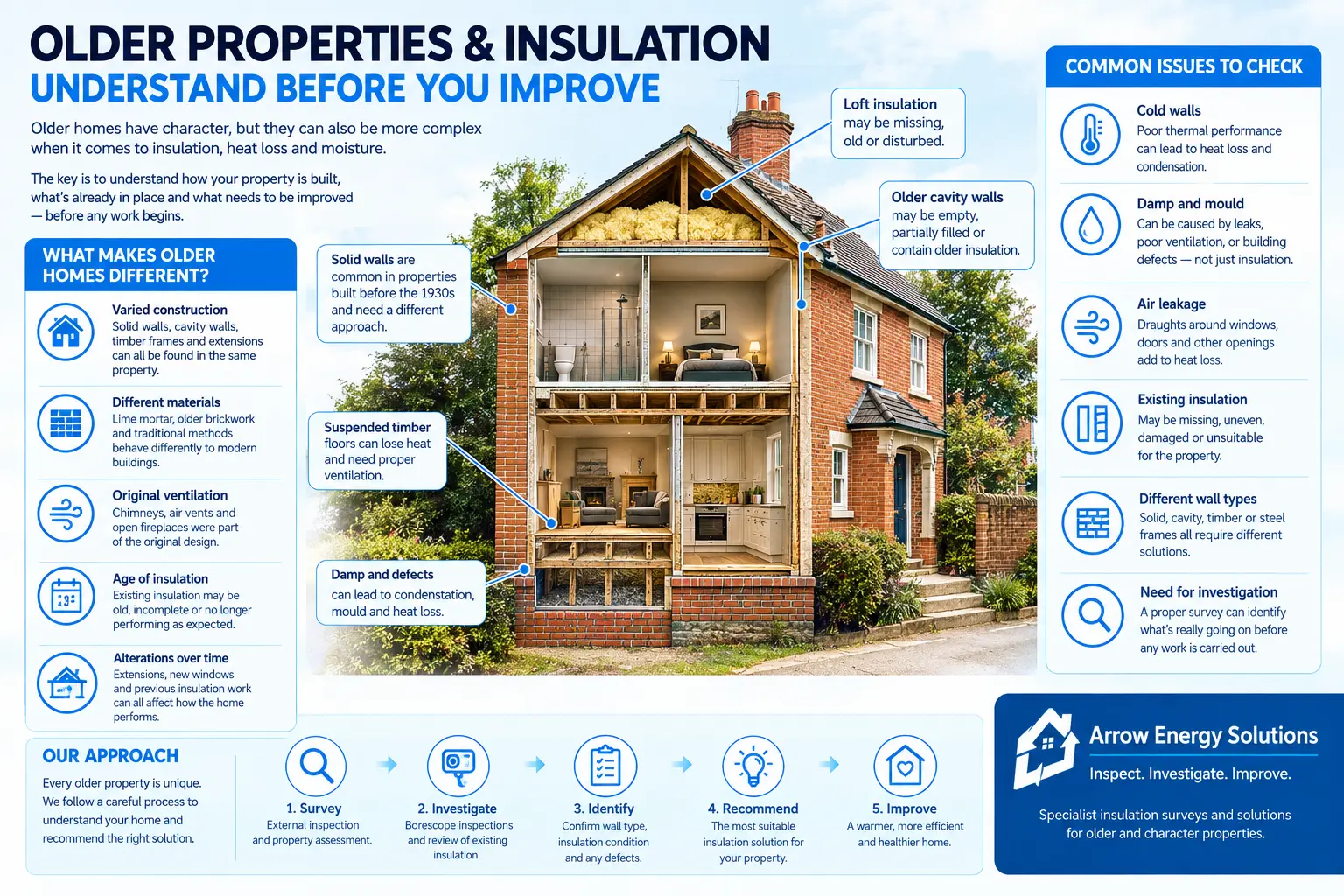
Older homes often have character, solid construction and features that are difficult to reproduce in newer properties.
But they can also behave very differently when it comes to heat loss, ventilation and moisture.
A property built 50, 80 or 100 years ago may have been constructed using materials and methods that were never designed around modern insulation standards.
That does not mean older homes cannot be improved.
It means the building needs to be understood properly before insulation work is carried out.
Older properties were often designed to manage moisture in a different way from modern buildings.
Construction may include:
Solid brick walls
Early cavity walls
Suspended timber floors
Lime mortar
Ventilated roof spaces
Uninsulated lofts
Timber-framed elements
Later extensions built differently from the original house
Over the years, many properties have also been altered.
Windows may have been replaced, chimneys blocked, extensions added, walls rendered and insulation installed at different times.
This means two houses of the same age can now perform very differently.
Many older homes built before the early 20th century have solid external walls rather than cavity walls.
Cavity construction became increasingly common during the first half of the 20th century and was widely used in later housing.
However, age alone should not be used to decide how a wall is constructed.
Some properties contain a mixture of:
Solid walls
Cavity walls
Extensions
Different brickwork
Altered elevations
The construction should be confirmed before insulation is recommended.
Many homes built from the 1900s onwards have cavity walls that were originally left empty.
Some were later insulated through retrofit schemes.
This means an older cavity wall may now be:
Completely empty
Fully insulated
Partially insulated
Filled with an older insulation material
Unevenly insulated
Contaminated with debris
Previously extracted and refilled
A visual inspection from outside cannot always confirm what is inside the cavity.
This is where borescope investigation can be particularly useful.
Retrofitted cavity wall insulation has been installed in UK homes for many decades.
Older materials can include:
Mineral fibre
Blown fibre
Urea formaldehyde foam
Polystyrene bead
Other historic systems
Age does not automatically mean that insulation has failed.
Some installations continue to perform correctly many years later.
However, older insulation can sometimes settle, deteriorate, become disturbed or be affected by changes to the building.
If there are concerns about cold walls, damp or previous insulation work, it can be sensible to investigate what is actually present.
A solid wall does not have a conventional cavity that can simply be filled.
Improving the thermal performance of solid-wall properties normally requires a different insulation approach.
This can involve internal or external wall insulation, depending on the property.
Before work is carried out, issues such as moisture movement, ventilation, detailing and the existing condition of the building should be considered carefully.
Using an unsuitable approach can potentially create problems rather than solve them.
Many older properties have suspended timber ground floors.
The timber floor is raised above a ventilated void beneath the property.
Air bricks around the outside of the building allow air to circulate below the floor and help keep the timber dry.
These ventilation routes should not be blocked.
When insulation or other building work is carried out, the existing sub-floor ventilation should therefore be identified and protected.
Older homes often contain chimneys, open fireplaces, air vents and other features that formed part of the original ventilation strategy.
Over time these may have been altered or blocked.
At the same time, replacement windows and other improvements may have made the building more airtight.
This can change how moisture behaves inside the property.
Insulation improvements should therefore be considered alongside ventilation rather than in isolation.
One of the most common complications in older properties is that different parts of the building were constructed at different times.
The original house might have solid walls, while a later extension has cavity walls.
Another extension may have already been insulated.
This can result in one room feeling warm while another remains noticeably colder.
Before carrying out insulation work, each part of the property should be considered separately.
Older properties can experience damp for many reasons.
Possible causes include:
Defective gutters
Roof leaks
Cracked render
Failed pointing
Ground levels
Plumbing leaks
Condensation
Blocked ventilation
Damp building materials
Problems within the cavity
Existing insulation is sometimes blamed immediately when damp appears.
But the insulation may not be the cause.
A proper investigation should consider the whole building before conclusions are made.
Older walls often have poorer thermal performance than modern insulated construction.
This can result in colder internal surfaces.
When warm, humid indoor air meets those colder surfaces, condensation can form.
Persistent condensation can then encourage mould growth.
Improving insulation can sometimes help by increasing internal surface temperatures, but ventilation and moisture generation must also be considered.
Not simply because it is old.
If insulation remains dry, correctly distributed and suitable for the property, there may be no reason to remove it.
Extraction may be appropriate where insulation is found to be:
Wet
Contaminated
Significantly incomplete
Poorly installed
Deteriorated
Associated with building defects
Preventing necessary remedial works
The decision should be based on investigation rather than age alone.
With an older property, understanding the construction is particularly important.
A specialist assessment may include:
External wall inspection
Identification of wall type
Borescope cavity inspection
Assessment of existing insulation
Investigation of damp or defects
Checking ventilation routes
Review of extensions and altered areas
This can help establish which parts of the property can be improved and which require a different approach.
Arrow Energy Solutions works with homeowners, landlords and property professionals to investigate insulation within older properties.
Our services include:
Cavity wall surveys
Borescope inspections
Existing insulation assessments
Cavity wall insulation extraction
Cavity wall insulation where suitable
Loft insulation
Investigation of cold walls and cold rooms
Photographic evidence and reporting
Older homes often need more investigation, not less.
The objective should be to understand how the property was built, what has changed since it was constructed and what insulation is already present.
Once that is understood, the appropriate improvement can be considered with far greater confidence.