
Many people assume that a bungalow will be easier and cheaper to heat than a two-storey house. After all, it is usually smaller and has everything on one level. However, new owners are often surprised to find that bungalows can feel noticeably colder and lose heat more quickly than expected.
The main reason is the amount of external surface area compared with the living space inside.
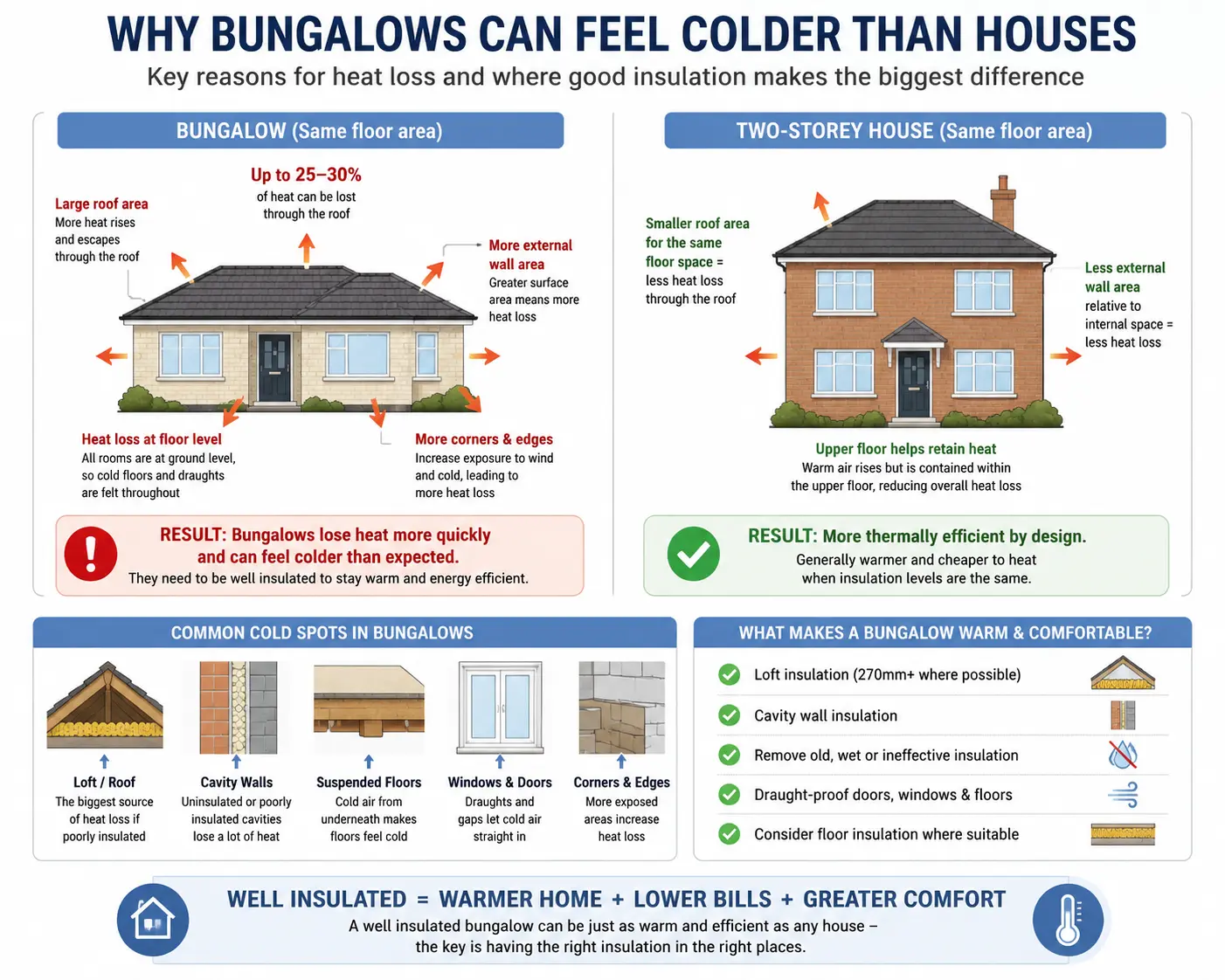
A bungalow usually has a much larger roof area than a house of a similar floor size. Because heat rises, a poorly insulated loft can allow a significant amount of warmth to escape through the roof. In a two-storey house, the same roof area may cover twice as much living space, making the building more thermally efficient.
Bungalows also tend to have more external wall area relative to their internal floor space. This means there is a greater surface through which heat can be lost, particularly where the cavity walls are uninsulated, poorly insulated or contain old insulation that has failed.
Suspended floors, exposed corners, larger windows and draughts around doors can make the problem worse. Because all rooms are at ground-floor level, cold air entering around the floors and external walls can be felt throughout the property.
A well-insulated bungalow can be warm, comfortable and economical to run, but the insulation must be suitable and correctly installed.
The main areas to consider are:
Upgrading the loft and cavity wall insulation can make a particularly noticeable difference because these are often the largest areas of heat loss in a bungalow.
Before purchasing a bungalow, it is worth checking what insulation is already present and whether it remains in good condition. Older properties may have little or no loft insulation, while existing cavity insulation may have settled, deteriorated or been affected by moisture.
A professional survey can help identify missing insulation, cold spots and potential defects before they become expensive problems.
At Arrow Energy Solutions, we survey, install and remove insulation in bungalows throughout the South of England. Our team can assess the property and recommend the most appropriate solution to help make it warmer, more energy efficient and more comfortable throughout the year.